australia’s bush country shows off its cultural attributes
the odometer reads 24,200km when the land rover sloshes out the gates of bindara farmstead into the sea of red mud leading to the mining town of broken hill. broken hill is “week 2, stop 1” on a three-week journey through the near reaches of the great australian outback. it hadn’t been planned that way, but the rain gods had forced cancellation of a stop in white cliffs, where we had been promised a room in an underground hotel. underground rooms don’t sound so delectable in a mud pond.
it’s been three days since a daylong downpour brought bush travel to a standstill in much of northwestern new south wales, stranding us at the bindara farmstead on the banks of the darling river. it’s ok, though. we had planned to spend three nights at bindara anyway, so the rainwater that flummoxed other travelers was actually well-timed for us. but now the hour of truth has arrived. can we navigate 60km of mud between us and sealed road?
our host at bindara, barb, has been consulting with friends and neighbors to get the latest on road conditions, and she’s fairly confident we can make it in our four-wheel drive vehicle if we’re cautious.
it’s a sunny morning, june 8th, as the land rover pulls out into the bush mush. despite the concerns of the locals, the wagon ploughs along the track quite efficiently, and we traverse the mud red sea at 25 to 35 km an hour, with occasional hiccups where puddles overtake the roadway.
broken hill is a pleasant surprise. we had listened to the talking heads from the tv networks in sydney or melbourne telling how miserable life is in outback mining communities. our tv news picture was of a lawless frontier town run amok with unemployed, wheezing miners aimlessly wandering the streets with no ambition, little respect for authority, and a worrisome dependency on australia’s famed “nanny state” for social services.

it’s a pile of rubbish, this tale of woe. sure, broken hill’s most eloquent structure is its miners memorial, dedicated to the hundreds of men and boys who died laboring in inhumane conditions in dimly lit shafts. the memorial tells the story of a 12-year old boy who fell to his death down a mine shaft, and of others electrocuted when they touched high-voltage power cables in the inky blackness.
And yes, the homes in broken hill tell a tale of hardship. many houses are rudimentary shanties that provided little more than a roof and a wood stove to come home to after a 16-hour day breathing noxious fumes in a hot, dark, poorly ventilated trench. But broken hill holds its head high, boasting of its accomplishments on behalf of its labor force. It’s a proud union town where people share a bond of backbreaking toil and trouble. to their credit, broken hill is a monument to their hard-won victory over the elements and the giant mining corporations that exploited the workers’ vulnerabilities to make their owners rich. broken hill reveres a hard day’s work and celebrates the indomitable human spirit.
Since we were a day early, our hotel at the imperial in broken hill was already booked for the night. Instead we stayed across the street at a budget motel. next morning we arose, immediately grabbed our things and drove across the road, (a distance of less than 100 meters), to the imperial, probably overpriced but a throwback to broken hill’s glory era. the town had its heyday more than a century ago, when the land baron sydney kidman controlled much of the outback and the sheep shearing stations were magnets for itinerant immigrants willing to take any job they could find to earn a subsistence wage. sound familiar, america?
broken hill is the largest town we’ve seen since we left canberra. and just as in the capital, where we live across the street from the canberra mosque, one of the first things we encounter while exploring broken hill is the city mosque.
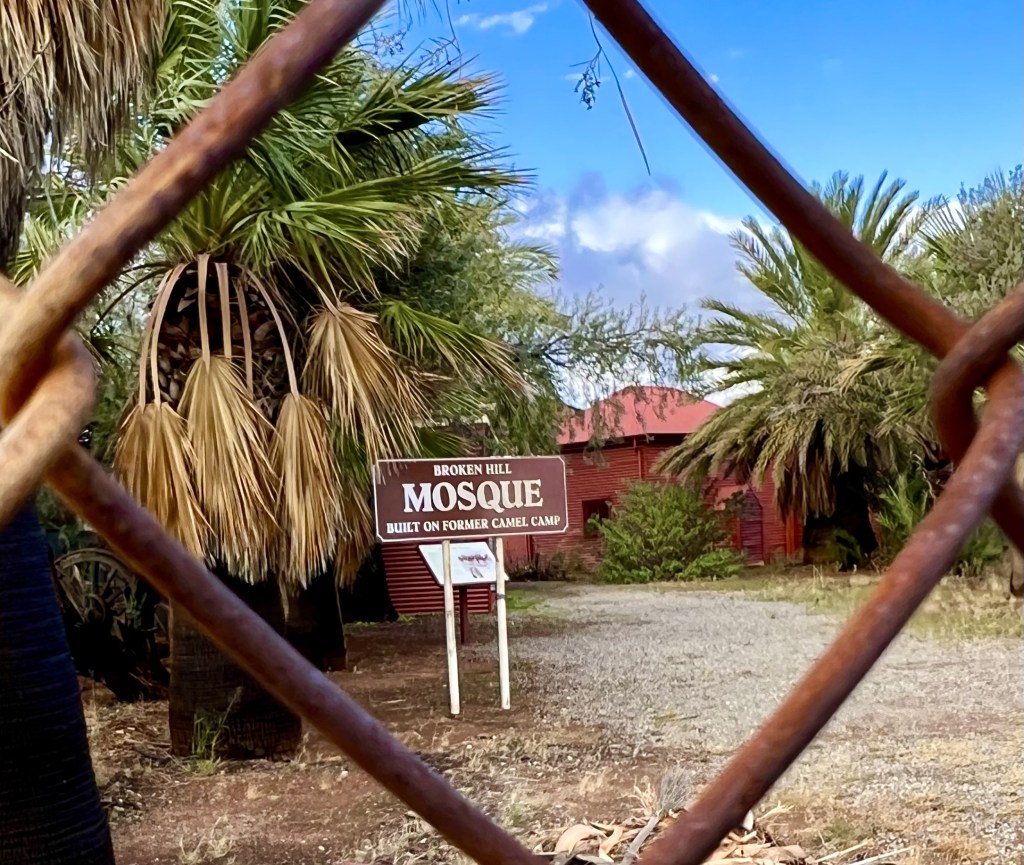
the gate is open, so we park and walk in, where to our surprise, a TV crew from ABC Sydney (australian broadcasting corporation) is just completing an interview with a mosque official. The official, it turns out, is a grandson of shawrose (probably transliterated from shahroz) khan, one of the original afghan “cameleers” who led the camel caravans that transported to market much of the wool on which the outback economy was built. we hadn’t known.

a little homework reveals that australia’s leaders were flummoxed in implementing their racist “white australia” policy as the nation prepared for federation in 1901 because, surprise, many of the “asiatics” they hoped to exclude from the country were in fact british subjects, just like them. (in those days, remember, the sun never set on the british empire.) that didn’t fully stop the white fellas from implementing their devious scheme, but it sure gave them fits as they attempted to pass legislation that would achieve their goal of keeping the brown fellas out without alerting the crown back in London to their intentions.
broken hill’s CBD (central business district) is an eclectic mix of the 19th, 20th and 21st centuries. people order food on the cellphone apps, while at the palace hotel on argent street, the town’s main thoroughfare, floor-to-ceiling murals depict a 19th century miner’s world where any food at all would have been welcome. argent street is a veritable modern shopping mall several blocks long featuring enticing stores and eateries reflecting the town’s ethnic diversity. among the attractions, we find the broken hill national park information center, where a delightful woman behind the counter (we forgot to ask her name, but we took her picture) spent many minutes going over with us the regional maps and info sheets that explain the historical and geological significance of far western new south wales and vicinity.


for all intents and purposes, broken hill is a city, not just an outback town. It sports a restaurant/pub district where you can enjoy fine dining (or drinking) with an excellent wine list featuring vintages from bordeaux or napa valley; or if your tastebuds are discerning and your palate more chauvinistic, maybe a bottle from margaret river in west australia, or mclarens vale in south australia. they’re all excellent. we chose beer.
but broken hill’s real secret is its art. mining art is, at first blush, an oxymoron, sort of like military intelligence, but the raw beauty of the region has attracted some discerning eyes able to see beyond the jackhammers and the saltbush to the magical sunsets and the pioneer spirit that compelled its founders to put down roots here.

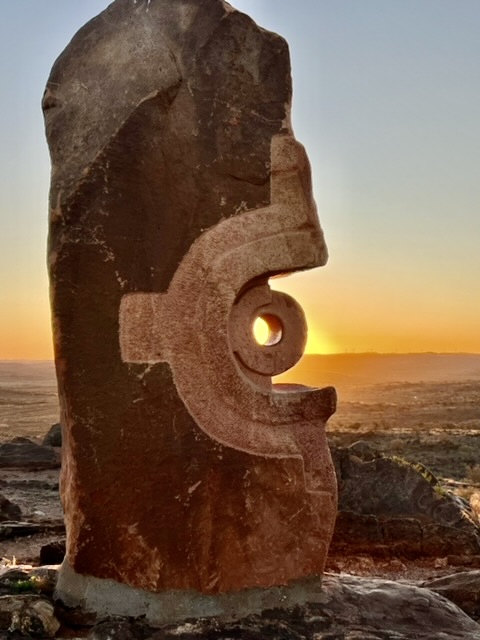
“broken hill sculptures” is an example. It’s located at living desert state park, several miles (kilometers) out of town on an expanse of red hills that glow at sunset.
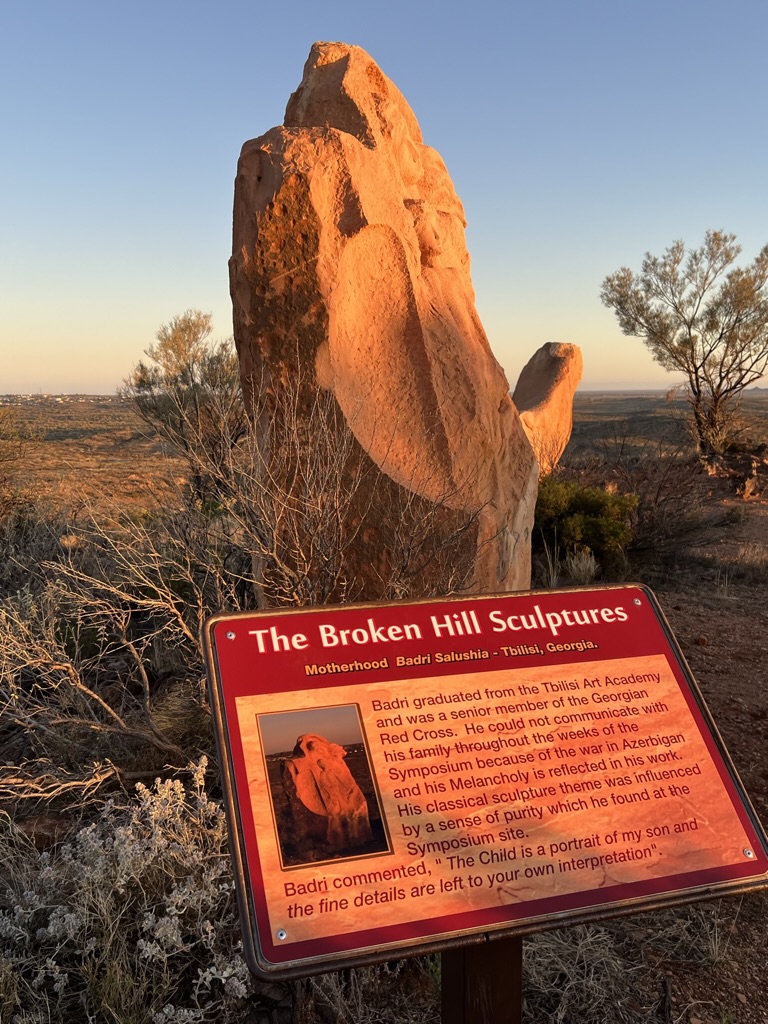
Each evening, as shadows fall over the saltbush and spinifex grass , locals and tourists alike gather in the sculpture garden to photograph a collection of fine art crafted by master sculptors from across the planet.

meanwhile, on a suburban street back in town, the pro hart gallery attracts a steady stream of tourists to view artist kevin charles “pro” hart’s scenes of life in 19th century outback australia.


We couldn’t help picking up a souvenir or two while there. Maybe a christmas gift for some lucky person.
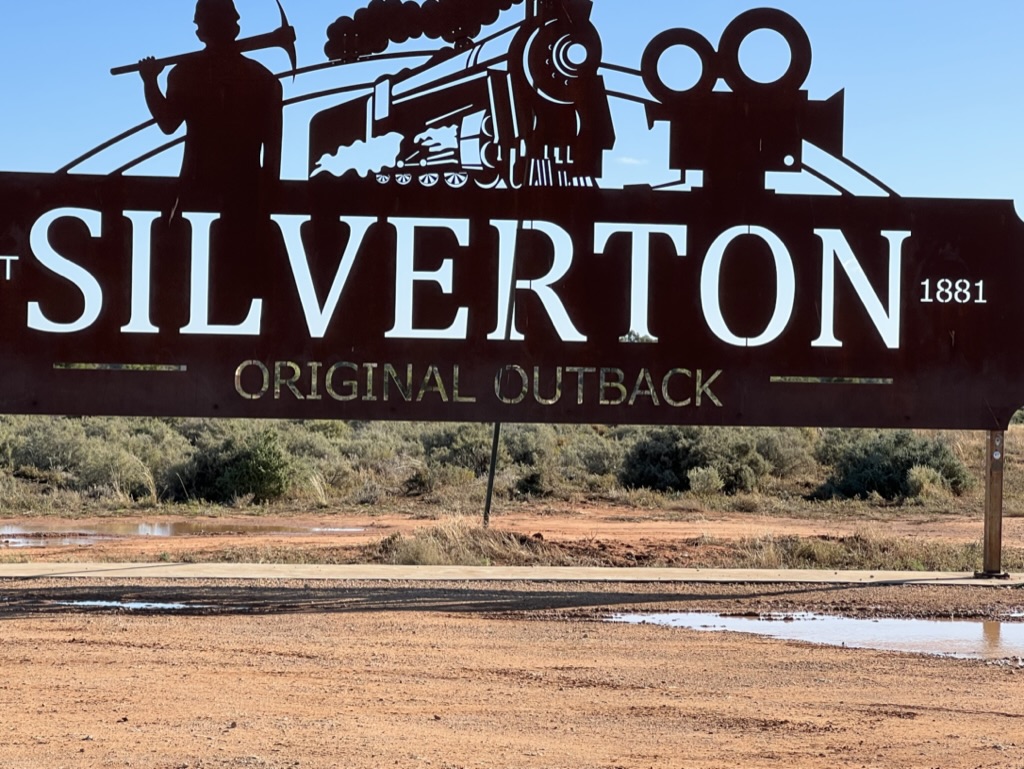
from broken hill, it’s worth a day trip to the mining village of silverton about 30km to the west. silverton is little more than a pub, a souvenir shop (art gallery) and cafe. it’s supposed to be where the “mad max” movies are made, but i can’t vouch for that. it’s authentic, though. it really was a gold rush boom town in the mid-19th century outback. it makes an impression, right down to the gaol (jail) museum that illuminates the life of wild west ne’er do well prospector/criminals paying the price for their crimes, as well as the jailers who kept watch over them. anyone contemplating a life of crime should visit the silverton gaol museum. It’ll scare the be-jeezus out of you.

From broken hill, the road northward leads to tibooburra , via the sackpaddle roadhouse. sackpaddle, sometimes also known as packsaddle, is basically a roadside pub where you can get a bed, buy souvenir t-shirts and top up your tank. suckers that we are, we bought a couple t-shirts. $58 a pop, but hard to get elsewhere. “we’re the only game in town” the clerk told us. she was wrong. there’s no town.

tibooburra may be the antithesis of broken hill, a spot on the map without any apparent reason for existing. it’s simply a curve in the road near the entrance to an out of the way national park, where some godforsaken souls have erected a service station and a hotel/motel/pub. We’re booked for three nights there. pernille’s been told it’s a great place for birding.
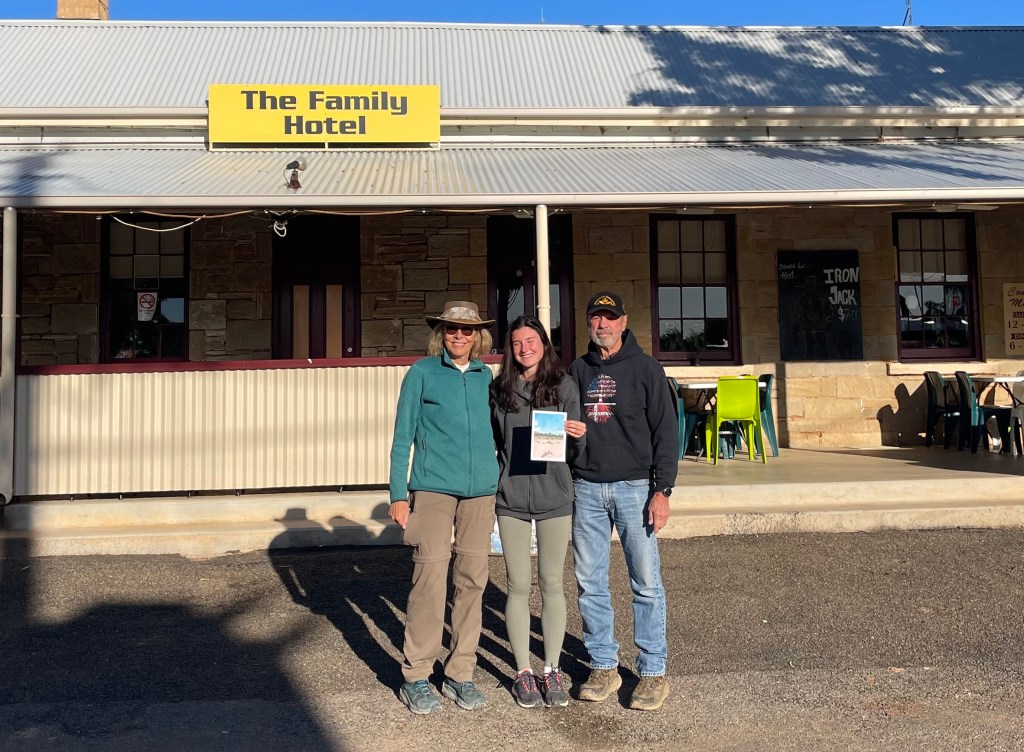
We check in at the family hotel, which Is directly opposite the family motel and gas pumps. The pumps partiallly explain why tibooburra exists. there’s a big diesel storage tank out behind the roadside pumps, making it a place where long-haul truckers could stop for fuel and possibly an overnight stay. the only other reason we could see was a life-size stuffed camel welcoming visitors at the entrance to town. holding the camel’s reins was a stuffed dark-skinned man wearing a typical afghan headdress. tibooburra, in addition to being at the entrance to sturt national park, which encompasses the northwest corner of new south wales, had once been a camel station!

We check in with the clerk at the family hotel, who leads us to our room. It’s in the back, just behind the bar. he opens the door to reveal a bed. that’s all. a bed. no nightstand, no chair, there’s no room for any of that. just a bed, which is not big but which takes up the entire room. The clerk then takes us down the hallway past a half dozen other “rooms” to show us the communal toilet facilities. I don’t know whether to laugh or cry. could this be where the long-haul truckers bed down for the night? I couldn’t imagine it.
fortunately, pernille found the manager, who informed her that, indeed, there were vacancies at the motel across the street, where traditional rooms with bathrooms attached could be had. Apparently, the terms ‘hotel’ and ‘motel’ in tibooburra mean the opposite of what they mean elsewhere. The motel was basic, but the rooms were several levels above the hotel facilities. For one thing, they were across the street from the bar, not right behind it.
After a restful(?) night’s sleep, we awoke and drove toward the queensland border, about 55km to the north. We knew the road in queensland had been closed since the rain, but we wanted to see how bad it was on the south side of the state line, approaching the border. There were rumors the queensland side would be open in a couple days, and our plans for the journey northward depended on it.
the individual states in australia are quite autonomous, to the point where, at least in the outback , fences mark the boundary lines. These heavy chain-link fences are ostensibly to keep wild dogs out, or in, depending on your point of view. Anyway, the gates are closed and unattended. Just past the fence on the other side of the state line we find a sign welcoming visitors to bulloo shire, queensland, but the sign doesn’t look all that inviting, and we already know the road is hazardous. We still have two days before traveling, and the sunny, dry weather is an ally.
It turns out the area around tibooburra is loaded with birds populating the semi-dry creek beds that cross the roadway. pernille stops at a creek just outside town and spots not one, but two birds she hasn’t seen before; the bourke’s parrot and the crimson chat. So score one for tibooburra. or two.
After a day scouring the bush, it’s back to base, where the sign on the hotel door informs that dinner is served from 6 to 9 p.m. it’s getting close to six, and as the hour approaches, there’s a rush of people toward the pub door. They’re apparently denizens of a bus that’s pulled into the town from god knows where.
Inside the hotel pub, we’re greeted by a crew of young people who are clearly not locals. For one, they don’t speak “strine”, the aussie version of english, and they all appear to be in their early twenties, whereas all the tibooburrians we’ve met make me look young (and feel old).
It only takes a sentence before we’re asked where we’re from. “texas,” I reply in my best southern drawl, sounding more like “tay-eck-sis”. “oh, we have a colleague from texas,”, one of them says. “Here she is”. And from the doorway appears a young woman wearing a dallas cowboys hoodie . She’s from ft. worth. rachel by name. not a cowboys fan, but hey. the other two are a young woman from the netherlands named jules and a fellow from nottingham in the u.k.. not a forest supporter, or even an english football fan, but a decent bloke who’s adept at drawing a perfect pint.
jules, we learn, is also a budding artist, and is making her first attempt at offering her work to the public. shy and humble, she’s offering them at whatever price a potential customer is willing to pay . “twenty-five dollars”, i offer, pointing to an attractive little watercolor in the display. “Yes,” she replies ecstatically. “that’s my first sale”.
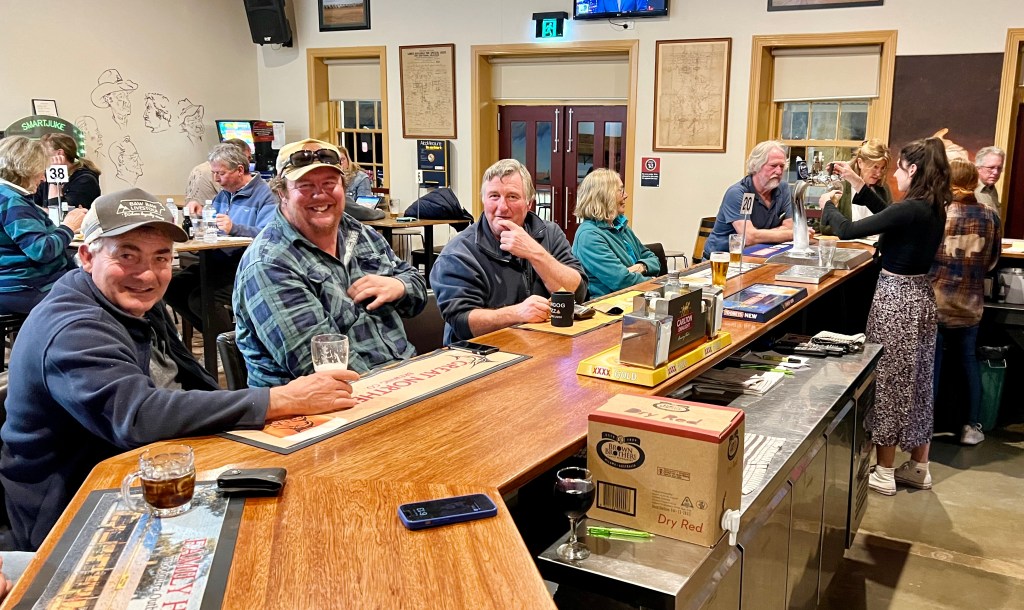
when we returned the next night for dinner (it was literally the only place in town), jules was talking to three men sitting at the bar. “they just bought a piece from me for $100,” she gushed. the three of them had commissioned her to do a portrait of them, and they were admiring it. not bad for a first-time amateur portrait artist. not bad at all.
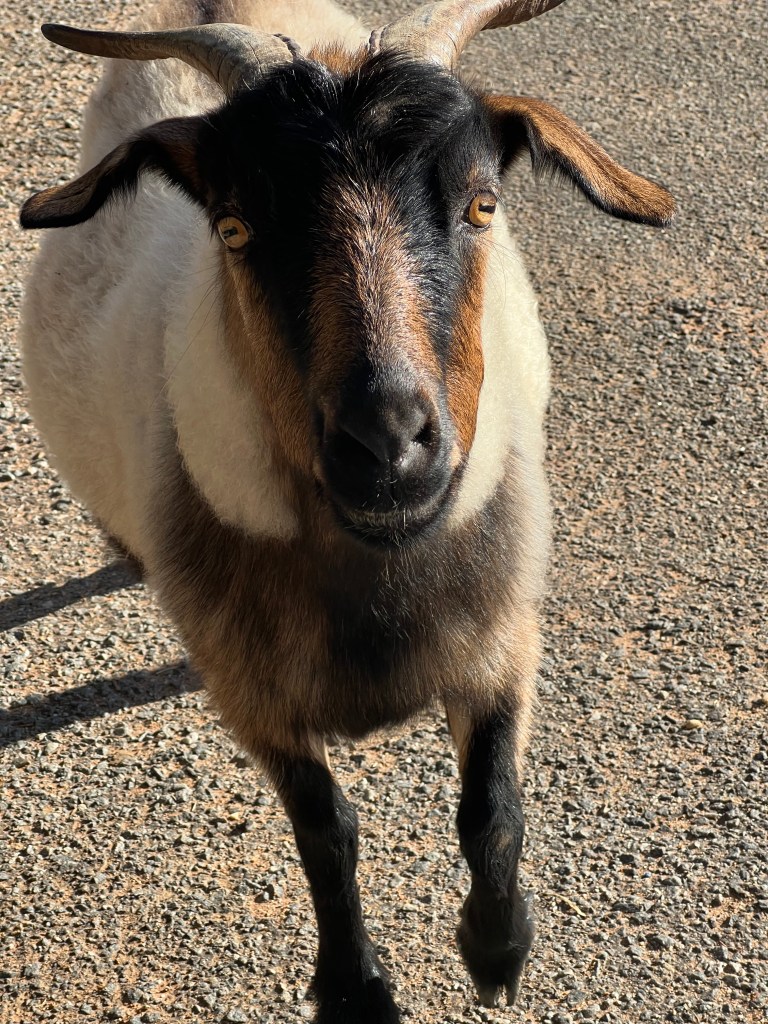
tibooburra may not be too long on people, but we learned it has a celebrity goat. we know this because he followed us as we wandered the street (singular), and wouldn’t let us go without taking his picture. he’s obviously been spoiled by people with cellphone cameras, and apparently thinks that’s what humans are for. he’s right. and to be truthful, he is photogenic.
The next morning we decide the best use of our time is to test the road going west toward cameron corner, a post at the intersection where new south wales, queensland and south australia all meet. cameron corner makes tibooburra look like Manhattan by comparison. It’s just a small shed in the middle of the open desert, the perfect definition of a barren outpost.

cameron corner is inhospitable by any standard, including the golf course. let me repeat that. … including the golf course. the golf course. just as we arrive, a foursome is checking out their gear at the clubhouse (the pub and only building in cameron corner) and heading for the front nine. (there are only nine. the mind boggles at the thought of what the back nine might be like at a place like this). It must be a quirk of the scottish- south australia sense of the ridiculous that requires a golf course anywhere there are people. st. andrews it ain’t, unless the holy man has become the patron saint of lost causes. but it has one unique attraction. the nine holes encompass all three states; three in each state. a family of four; father, mother and two daughters, have taken the bait, trudging through the sand, dodging spinifex bushes to reach “greens”, which are not green at all, but in fact are oil-soaked mud flats carved with gullies from the rains. The first hole is a par 3. scores among the foursome were 6, 9, 11 and “i don’t know”, but everybody made par, somehow. (tally courtesy of price-waterhouse.)
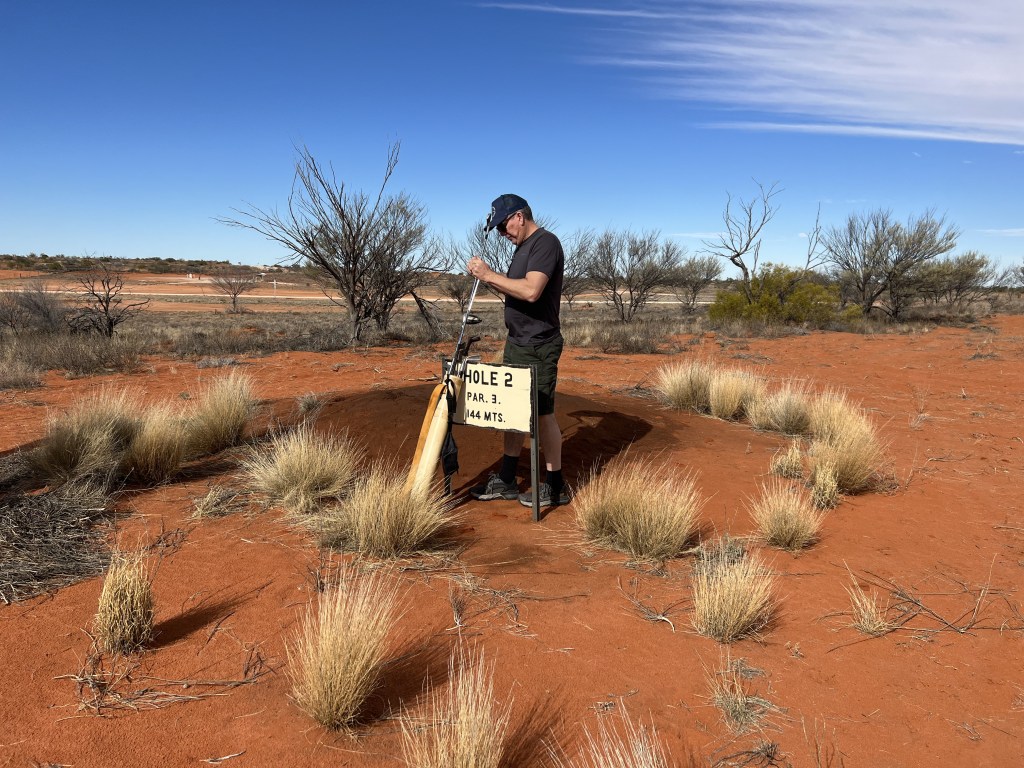
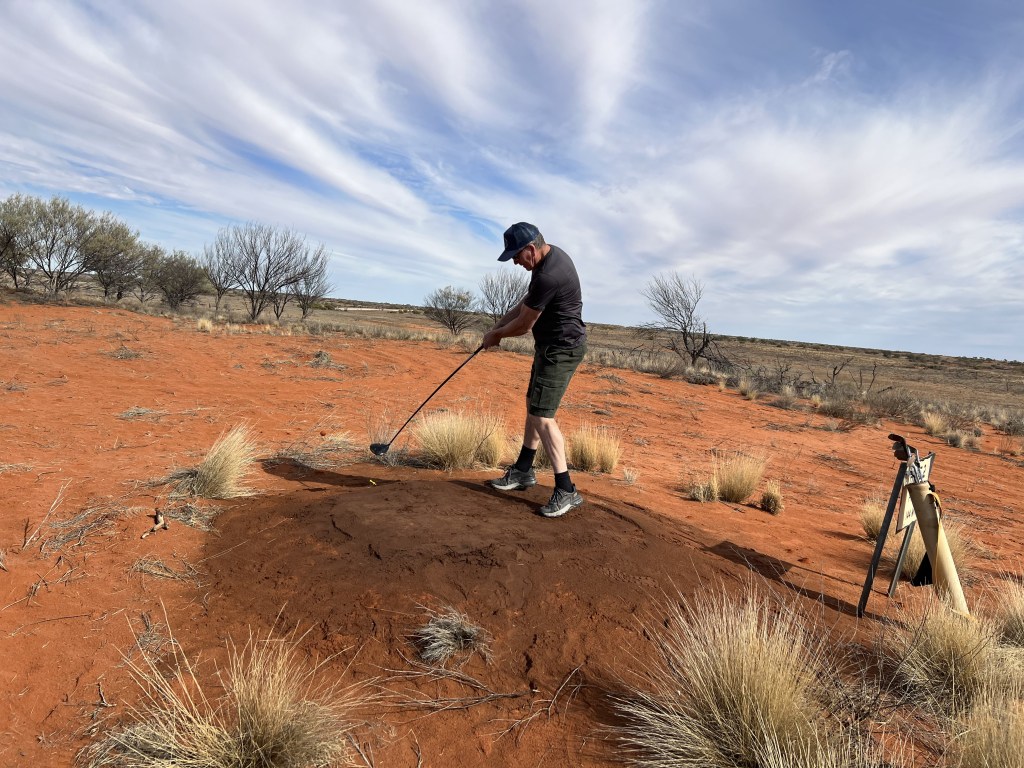

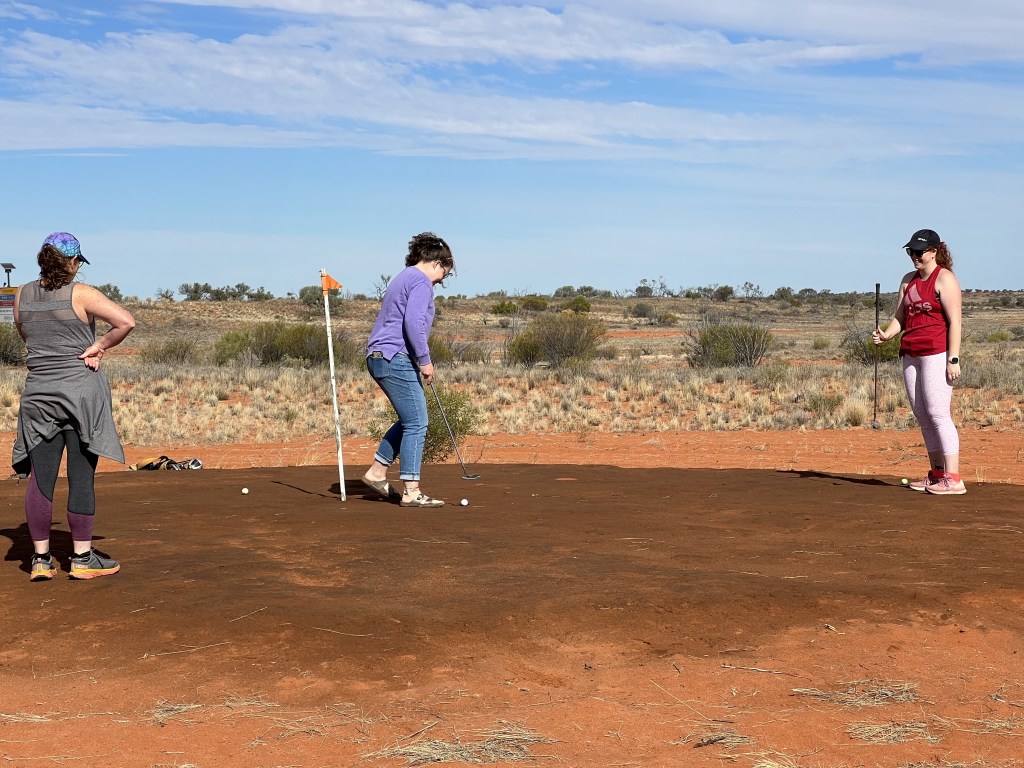
as we d rove away from cameron corner on the way back to tibooburra, we could see the four of them wandering the desert of south australia, searching for their balls. they may still be there.

the following morning we steeled our nerves, packed up the car, and turned north toward the queensland border, this time for real. at the frontier fence we encountered three other couples standing just outside the gate, contemplating whether to risk the trip, given that the road had just opened that morning, following the floods. throwing caution to the winds, we flung open the gate and headed into the abyss of southwestern queensland for week three — the final leg.
to be continued
to be continued
 not that heinlein