storeys and stories galorese

belgrade, here we are.
our personal effects, furniture, clothing, our entire lives lie in a container, presumably on the high seas somewhere between continents. but we, our suitcases, and our dog billabong, are on the ground in serbia, ready for whatever.
the older we get, the more we look forward to single-storey homes. each of our residences in canberra was mostly devoid of stairs. but our place in the serbian capital, provided by the government, is stairy. it’s got so many floors we don’t even go to some of them. it’s even got an intercom so you can converse with people a few floors away. we haven’t used it yet. but workmen (it’s only men in serbia) fiddled with it for days, without apparent success. and a dumwaiter. it’s used for transporting groceries from the garage up to the dining areas on the levels above. at least it works.
it would be easy to imagine that the stucco walls of our new house at 48 uzicka (pronounced OO-zhitch-ka) street were pock-marked by small arms fire in the battle for belgrade. it looks that way. the truth is, though, that the “shell shock” effect appears to have been done by design rather than in error. at least we’ll give the architects the benefit of the doubt.

as the story goes, the house was originally built to be the home of belgrade’s royal tailor. the position of royal tailor was probably prestigious in the days before off-the-rack department stores. we sometimes neglect to ask who it was that made the king’s clothes back in the before-times? and which king? the royal tailor probably made clothing for the entire royal family, and in the days before planned parenthood, that could have been quite a load of laundry.
the back face of the house may be even more imposing than the front. it showcases the steep slope on which the structure stands.
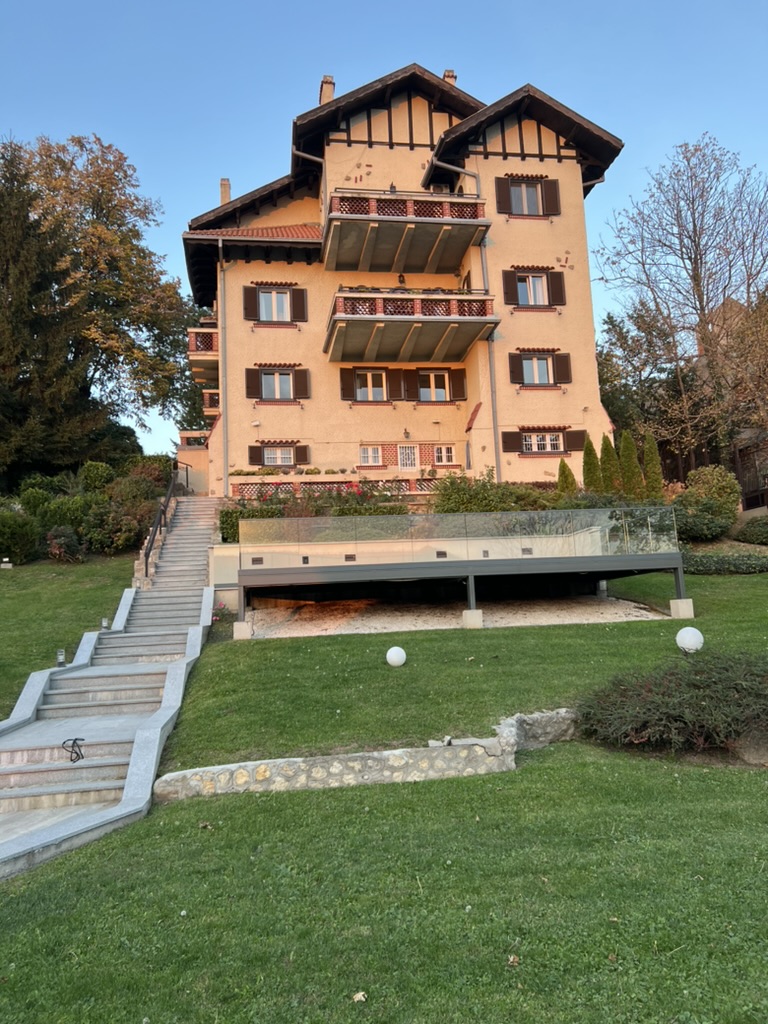
close your eyes for a moment and envision what it must have looked like nearly a century ago, with the king’s underwear hanging from a clothes line strung from the ground-floor laundry room down to the back lawn below.
uzicka street (known to locals as “ulitsa uzicka” – a mouthful) is a storied address, among the most coveted neighborhoods in the serbian capital. it houses the official residence of the president of the now-defunct yugoslavia, home to its legendary (some might say infamous) 20th century communist leader josep broz “marshal tito”. the residence was also home to tito’s successor slobodan milosevic. the current serbian president, alexander vucic, however, has shunned the ulitsa uzicka residence, apparently preferring to live elsewhere in the capital, though the neighborhood folks i’ve talked to don’t seem to know exactly where. or if they do, they’re not telling americans. don’t forget, NATO warplanes bombed belgrade. just a quarter of a century ago, (in 1999) “accidentally” hitting the chinese embassy. silly blunder, that.
but other prominent personalities are not following their leader. the patriarch of the serbian orthodox church, for instance, is still living on ulitsa uzicka, (he’s our next door neighbor) and several ambassadorial residences dot the narrow winding asphalt strip, including those of the u.s., china, canada, qatar, sweden, austria, iraq, and others, all within rock-throwing distance. fortunately, rock-throwing seems to have declined in popularity of late. but if it should come back into vogue, our height advantage should give us the upper hand against any upstarts who might attack from below.

a little further down the road , however, is a prime example of why ulitsa uzicka is still THE bougie address in belgrade.

the owner of a popular reality TV station in belgrade known as “pink TV” is putting the finishing touches on a palace that must rival india’s taj mahal for opulence. word on the street is that the mansion is the businessman’s way of showing off his close relationship with president vucic. of course who knows what will happen when the next president comes along.
it’s been a while since we moved to a place where we don’t know the language, the culture, the people, or much of the history. serbia is a country that didn’t exist for much of the twentieth century, when twice belgrade was the capital of yugoslavia. (that’s right, twice) but after tito died in 1980, removing his towering presence from the political landscape, the artificial multi-ethnic construct that was yugoslavia quickly crumbled under the weight of its contradictions. today the region has been, shall we say, balkanized. so now we have croatia, bosnia-herzegovina, north macedonia (greece demanded that, as a condition for candidacy in the EU, that the “north” be tacked on so as to avoid confusion with the greek region of macedonia), montenegro, and slovenia, in addition to serbia– all members of the united nations. and don’t forget kosovo, whose status is in limbo.

directly behind tito’s old residence on the next street over from ulitsa uzicka (basically tito’s back yard) is the yugoslavia museum. it’s become one of belgrade’s biggest tourist attractions, a historical reminder of the socialist/communist ideals that held sway in central and eastern europe for much of the 20th century, and a monument to josip broz “tito”, the yugoslav leader entombed there.

for the moment, we’re still awaiting the arrival of the container we packed in canberra way back in july. therein lies our entire lives, including household goods and clothing. until that container shows up, we’re in a kind of purgatory, not completely whole, living out of suitcases. in the mean time, we’ll survive on a diet of tall storeys from the old royal tailor’s residence on ulitsa uzicka.
-30-
 not that heinlein