the ups and downs of multi-storey belgrade

storeys and stories galorese

ulitsa uzicka 48, home

belgrade, here we are.

our personal effects, furniture, clothing, our entire lives lie in a container, presumably on the high seas somewhere between continents. but we, our suitcases, and our dog billabong, are on the ground in serbia, ready for whatever.

the older we get, the more we look forward to single-storey homes. each of our residences in canberra was mostly devoid of stairs. but our place in the serbian capital, provided by the government, is stairy. it’s got so many floors we don’t even go to some of them. it’s even got an intercom so you can converse with people a few floors away. we haven’t used it yet. but workmen (it’s only men in serbia) fiddled with it for days, without apparent success. and a dumwaiter. it’s used for transporting groceries from the garage up to the dining areas on the levels above. at least it works.

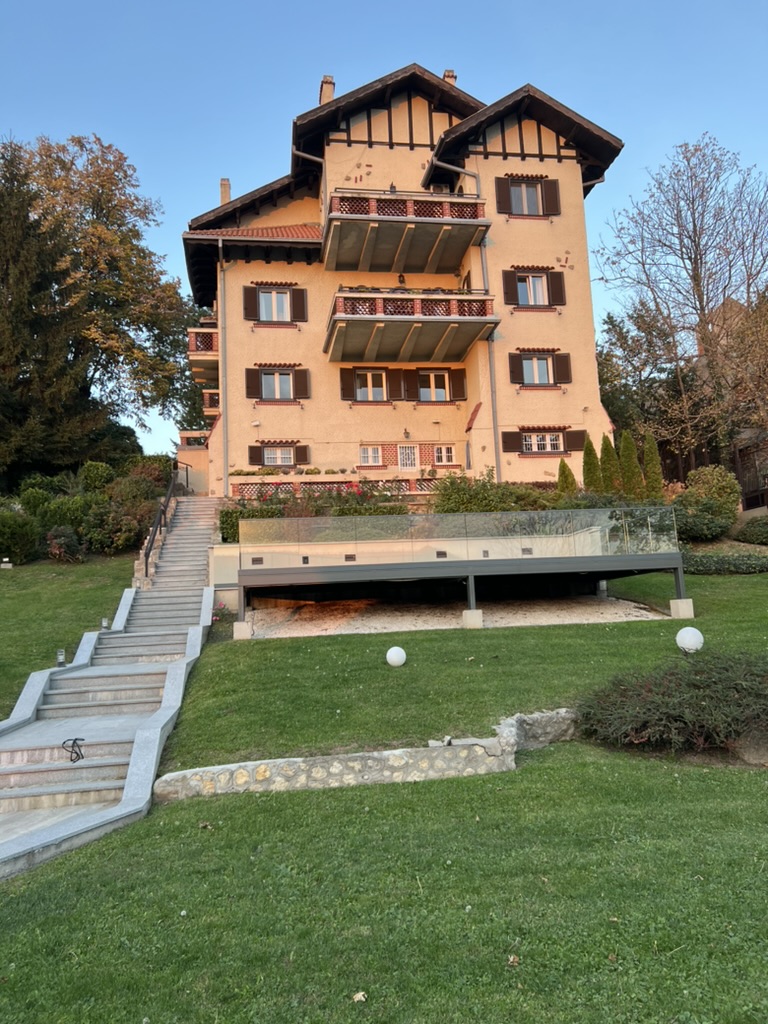
it would be easy to imagine that the stucco walls of our new house at 48 uzicka (pronounced OO-zhitch-ka) street were pock-marked by small arms fire in the battle for belgrade. it looks that way. the truth is, though, that the “shell shock” effect appears to have been done by design rather than in error. at least we’ll give the architects the benefit of the doubt.

as the story goes, the house was originally built to be the home of belgrade’s royal tailor. the position of royal tailor was probably prestigious in the days before off-the-rack department stores. we sometimes neglect to ask who it was that made the king’s clothes back in the before-times? and which king? the royal tailor probably made clothing for the entire royal family, and in the days before planned parenthood, that could have been quite a load of laundry.

the back face of the house may be even more imposing than the front. it showcases the steep slope on which the structure stands.
the back yard

close your eyes for a moment and envision what it must have looked like nearly a century ago, with the king’s underwear hanging from a clothes line strung from the ground-floor laundry room down to the back lawn below.

uzicka street (known to locals as “ulitsa uzicka” – a mouthful) is a storied address, among the most coveted neighborhoods in the serbian capital. it houses the official residence of the president of the now-defunct yugoslavia, home to its legendary (some might say infamous) 20th century communist leader josep broz “marshal tito”. the residence was also home to tito’s successor slobodan milosevic. the current serbian president, alexander vucic, however, has shunned the ulitsa uzicka residence, apparently preferring to live elsewhere in the capital, though the neighborhood folks i’ve talked to don’t seem to know exactly where. or if they do, they’re not telling americans. don’t forget, NATO warplanes bombed belgrade. just a quarter of a century ago, (in 1999) “accidentally” hitting the chinese embassy. silly blunder, that.

but other prominent personalities are not following their leader. the patriarch of the serbian orthodox church, for instance, is still living on ulitsa uzicka, (he’s our next door neighbor) and several ambassadorial residences dot the narrow winding asphalt strip, including those of the u.s., china, canada, qatar, sweden, austria, iraq, and others, all within rock-throwing distance. fortunately, rock-throwing seems to have declined in popularity of late. but if it should come back into vogue, our height advantage should give us the upper hand against any upstarts who might attack from below.

the view at dusk looking out the back balcony toward the road below and the school across the street

a little further down the road , however, is a prime example of why ulitsa uzicka is still THE bougie address in belgrade.

this palace at #1 ulitsa uzicka is a private residence

the owner of a popular reality TV station in belgrade known as “pink TV” is putting the finishing touches on a palace that must rival india’s taj mahal for opulence. word on the street is that the mansion is the businessman’s way of showing off his close relationship with president vucic. of course who knows what will happen when the next president comes along.

it’s been a while since we moved to a place where we don’t know the language, the culture, the people, or much of the history. serbia is a country that didn’t exist for much of the twentieth century, when twice belgrade was the capital of yugoslavia. (that’s right, twice) but after tito died in 1980, removing his towering presence from the political landscape, the artificial multi-ethnic construct that was yugoslavia quickly crumbled under the weight of its contradictions. today the region has been, shall we say, balkanized. so now we have croatia, bosnia-herzegovina, north macedonia (greece demanded that, as a condition for candidacy in the EU, that the “north” be tacked on so as to avoid confusion with the greek region of macedonia), montenegro, and slovenia, in addition to serbia– all members of the united nations. and don’t forget kosovo, whose status is in limbo.

directly behind tito’s old residence on the next street over from ulitsa uzicka (basically tito’s back yard) is the yugoslavia museum. it’s become one of belgrade’s biggest tourist attractions, a historical reminder of the socialist/communist ideals that held sway in central and eastern europe for much of the 20th century, and a monument to josip broz “tito”, the yugoslav leader entombed there.

tito’s tomb

for the moment, we’re still awaiting the arrival of the container we packed in canberra way back in july. therein lies our entire lives, including household goods and clothing. until that container shows up, we’re in a kind of purgatory, not completely whole, living out of suitcases. in the mean time, we’ll survive on a diet of tall storeys from the old royal tailor’s residence on ulitsa uzicka.

-30-

wa-a, wa-a, the end, good-bye

editor’s note: this blog post, our last from australia, is being published after our departure from down under. we sincerely apologize for the delay, which was due to unavoidable schedule conflicts and miscommunication between me and my long suffering and patient editor, kevin lynch. and thank you, kind readers, for enduring all the technical hassles that are endemic to luddite blogposting.

we’ll soon be off to our next post, belgrade, where pernille will pursue her diplomatic career and i will tag along for the ride. with a bit of luck, we’ll be in touch again once we get settled in serbia.

meanwhile, please indulge us and pretend this is june, 2024 and we’re still in oz as you read this.

and now, on to the post.

from waves to caves, an encore visit to the west coast

it’s sunset for us in oz. july 18th is “wheels up”, back to the unfamiliar shores of europe, the end of a fabulous four year tour. so for a grand finale, we hopped a plane to one of our fave spots, wa. wa, as in western australia, known by aussies simply as w-a. knowing aussies, i’m sure they’ve thought of ways of shortening the “w”, and maybe just call it “dub”; or for purists, maybe “dub-a”. they’ve already got a town called dubb-o. one can only imagine what dubbo must have been before the abbreviators got hold of it.

in strine, (aussie-speak), mates grab an eskie of coldies and hijack the telly for the footy match in tassie. hang with the tradies (working class) and you’ll meet chippies (carpenters) and sparkies (electricians) and firies (firefighters) and humpies (not sure what they are) and on and on in unintelligible gibberish. usually, someone mercifully breaks and does a translate for visitors. we have a friend, mark binskin by name, a retired royal air force general and former chief of the ausie defence forces, (i.e. a very distinguished fellow) who is known simply as “binnie”. call him binskin and you draw blank stares from aussies. say binnie and their faces light up. he’s a myte (mate for your non-aussies).

so with 30-odd days and counting, we’re off to w-a for an encore. it’s mid-winter (june) so there are only a few dozen surfers (what???) at the mouth of the margaret river heading down toward antarctica, a favorite of the surfing class. but no worries, as aussies say, there’s a warm current that heats the water up to a comfortable 70 degrees fahrenheit (21 celsius). heck, these old bones need 90 fahrenheit (32 celsius) before they uncreak. even my relatively youthful scandinavian spouse doesn’t appreciate 21 celsius. but this is w-a. w-a w-a w-a. the sound of a shivering me crying my eyes out at the mere suggestion of surfing (or even toe-dipping) in 20 degree celsius waves.

the vino along the w-a coast has a warming effect, however. maybe that’s what keeps those surfers afloat. or maybe it’s the price of the wine, which never goes down, no matter the weather. imbibe the juice of those grapes for long and you’ll have trouble keeping your head above water, both literally and figuratively. sometimes that’s blamed on the sharks.

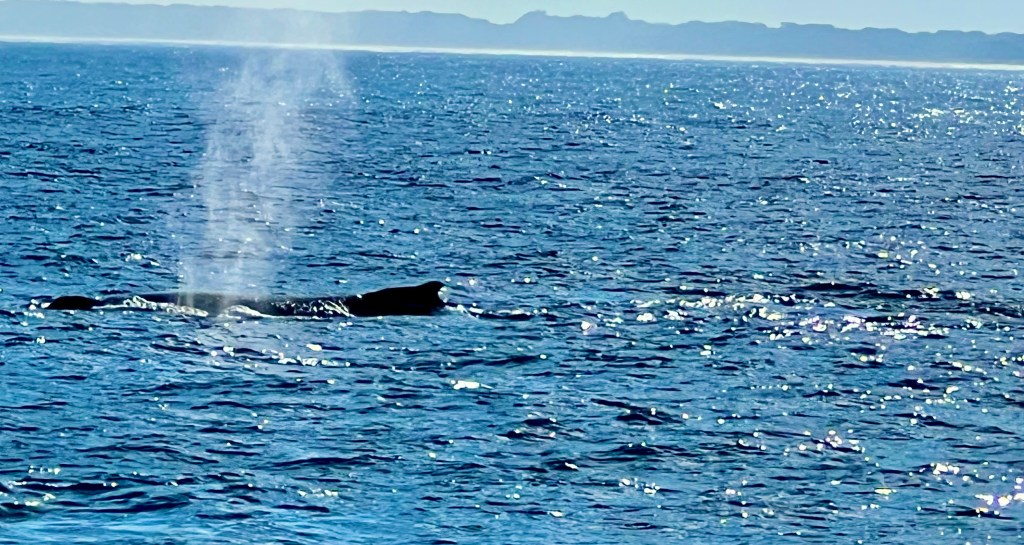
to keep well above water level, we opted for whale watching. about 80-thousand of these 30-ton sea mammals migrate north from antarctica to the milder waters of the north australian tropics for the winter in may-june, so we just had to go half a mile off shore, drop anchor, and wait for these playful fellows to perform their morning whale-o-batics. our guide said these humpback whales are like little kids; they can’t wait for an audience to show up so they can do their tricks, and they did. not as cute as jumping dolphins, but a LOT more intense. you wouldn’t want these monster acrobats flapping their whale-tales too close to your boat. but they understand that, and keep a respectful distance.

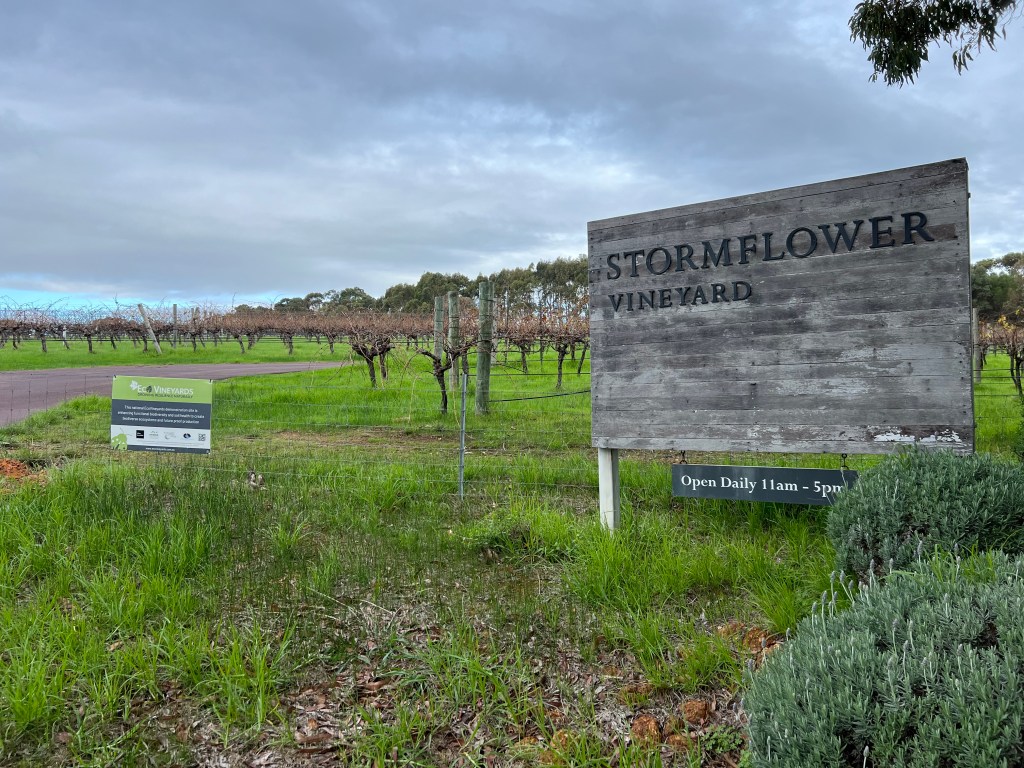
the vineyards are still booming in margaret river, oz’s finest wine region. regular readers will know we’re not winos, but we’ve found a cabernet sauvignon from the stormflower winery that knocked our socks off. looks as if socks are being knocked off all over the place . best not to wear socks in margaret river, it seems, lest they be knocked off. i could imagine heaps of socks littering the lanes around the caves road vineyard region

no socks!

.

speaking of caves, we’ve seen a few, but none more spectacular than the margaret river cape caves. i’ve been to carlsbad caverns in new mexico, which are massive (though it’s been many decades since the last time), but i don’t recall them being any more spectacular than the ones just off the side of caves road. our verdict: awesome. especially after a wine-tasting tour. (but don’t overdo it.)

vines in winter, sockless

we’ve been waiting three years to visit one of w-a’s most talked-about attractions, the horizontal falls off australia’s tropical northern coast. (they do). it’s winter, so high season for “horizontal falling””. but how does one photograph water falling sideways? truth is, it only falls a couple meters, at least while we were there. so it’s hard to photograph. but the force of the water gushing through a narrow passage from one pool of water to another has to be experience to believe. david attenborough visited the falls at one time, and through a mathematical calculation determined that a million liters of water passes through the falls every second. we defer to david’s superior knowledge.

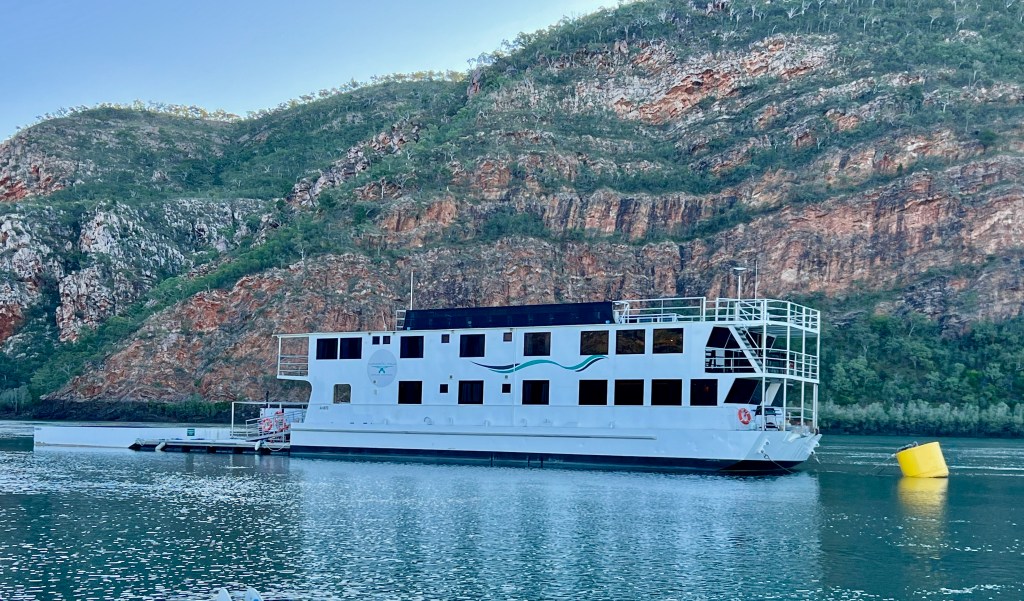
our previous attempts to visit the falls were stymied, first by covid, then by the weather, but third time’s the charm, and we’ve booked an overnight stay on a deluxe houseboat just outside the falls. so we jump on a seaplane, yup, the kind that lands on skis, and ferry out to the houseboat, which is parked in a little inlet away from the falls (to avoid accidental slips and falls, we assume).

the houseboat is in shallow waters just off shore

the houseboat can be a bit disconcerting to first-timers. we got to our room and looked out the window to a big mountain facing us on the nearby shore. a little while later we looked out again and…no mountain. in its place was an inlet that looked as if it was the passage through which we had come on the ferry. the secret we learned is that the boat is anchored on an axis in relatively shallow water, so it’s constantly rotating, like the revolving restaurant atop the space needle. what you see at one point is gone next time you look. if you keep looking long enough, it will come back, but only after doing a full 360. don’t hold your breath.

so it’s “au revoir” from oz for us. it’s been an eventful four years. but as they say, all things must pass (like last night’s tacos). australia, in all seriousness, has been the experience of a lifetime, as close to heaven on earth as we ever could have imagined. thanks to the aussie people, whose warm hospitality has shone through in every moment of our stay, never wavering. as we head back north of the equator after four years here, we feel as if we’re leaving home.

australia, we’ll miss you. cheers, mates.

-30-

tim tam(worth), slim (dusty) slam (worth it!)

the spirit of the king of aussie country lives and breathes in the annual tamworth country music festival.

slim dusty looks down on aussie country superstar lee kernaghan’s performance at tamworth country music festival

two weeks a year, at the height of summer, outback australia lives a fairy tale called tamworth. the ghost of slim dusty rises from his grave singing songs every aussie country music fan knows by heart. parents bring their kids, kids bring their parents, families reunite in caravan parks and dingy motels to revisit and revive the music that made them aussie.

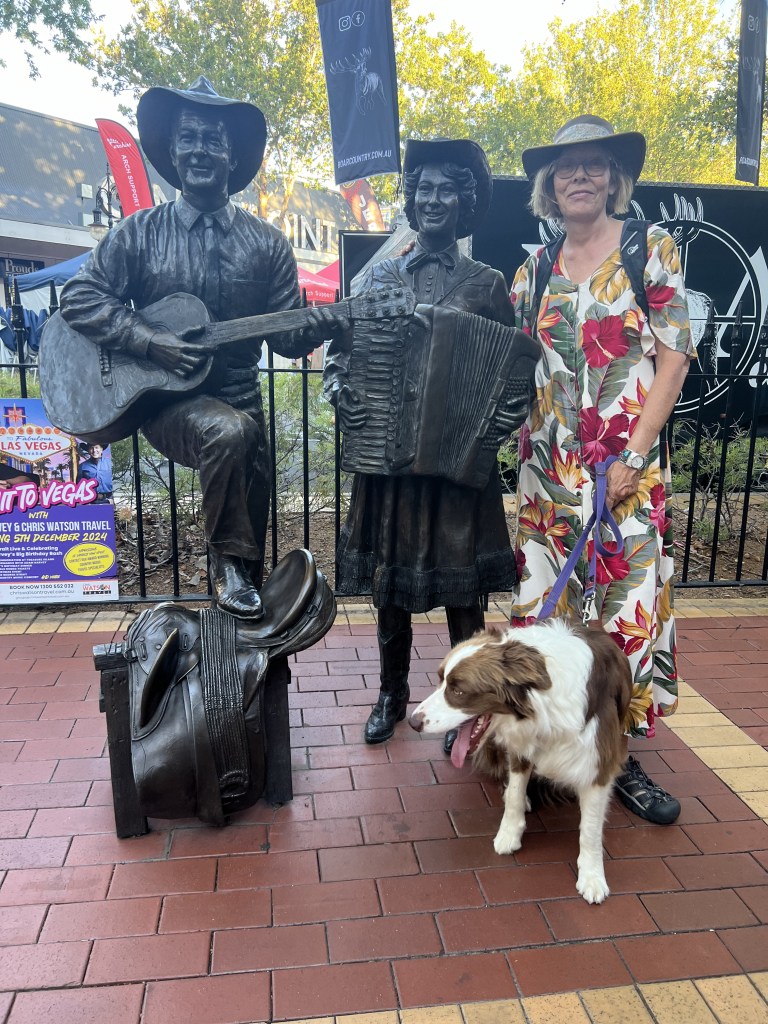
more than two decades after his soul passed into country music heaven, slim dusty’s aura still pervades the many stages and sidewalks of the tamworth country music festival. buskers lining peel street, tamworth’s CBD (aussie for central business district) , cover slim dusty classics, and if they’re old enough to have known the great one, spin yarns of their encounters with him and how he affected their career paths. in the sacred center of peel street stands a statue of dusty and his partner in life and song, joy mc kean.

from left: slim, joy, billabong and pernille pose on peel st.

tamworth is small town australia.  neat, orderly, law-abiding, church-going, family-oriented, friendly. for fifty weeks a year, there’s not much to distinguish tamworth from dozens of other tidy communities that dot the countryside of new south wales, west of the great dividing range that separates bush country from the coast, where the great majority of the population lives. but for ten days every january, tamworth transforms into the capital of australian country music, a genre that captures the hard-working, hard-drinking, god-fearing spirit of the aussie bush.  here, slim dusty is next to god. or maybe, IS god.

this year’s TCMF, as it’s called, featured some of australia’s biggest country music stars in concert, with lots of “guest appearances” by the big name performers at each other’s shows. troy cassar-daly and lee kernaghan, two of the genre’s veterans, filled the four-thousand seat tamworth regional entertainment and civic center (TRECC) on consecutive nights, doing a cameo appearances at each other’s concerts. they joined forces for a cover of a slim dusty classic written by joy mckean in 1972.

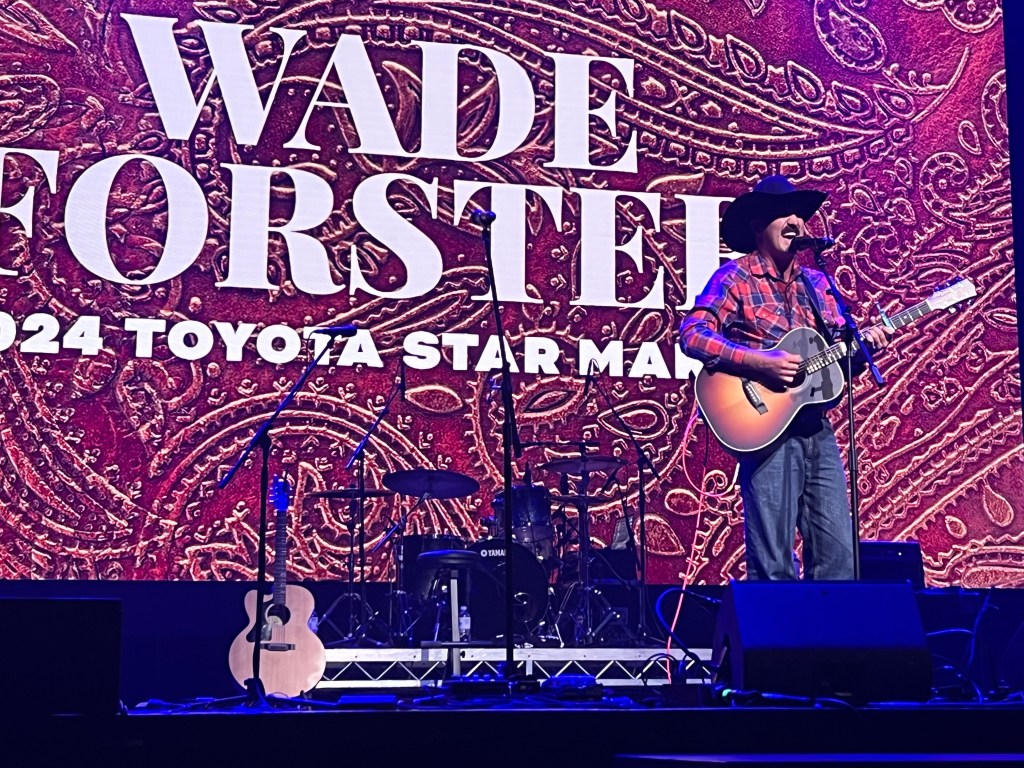
these TRECC concerts were sellouts , but at AU$65 to AU$75 (maybe US$40 or so) a seat, they’re not the main attraction for the estimated 300,000 country music fans who visit the festival each year. most folks come for a free peek at aussie country music’s future. of the big names we saw in concert, almost all stumbled over themselves to tell stories of starting out busking the streets of tamworth, playing for spare change from passersby. some of the best of this year’s crop were stevie wright, a nine-year old keyboardist who we saw doing an impressive cover of lynyrd skynrd’s 1970s classic “simple man”, and wade forster, a mustachioed youngster wearing a hat four sizes too big for his head, who won the “toyota starman” competition. wait 20 years, these will be tamworth’s headline names.

wade forster, sporting the hat he’ll be wearing when he hits the big time

peel street is a buskers jungle during the festival. walking along the avenue is like scrolling across an AM radio dial, moving from one musical orbit to another. it’s momentarily jarring as one song fades out and another fades in. but it rocks if you let it.

down peel street we wandered to town hall on saturday morning, the final day of the festival, to see “fanny”. we hadn’t a clue beforehand, only tickets purchased online for “fanny at town hall . town hall isn’t a premier venue, but fanny and her band blew us away. “fanny and the prawnstars”, all (except fanny) wearing red jumpsuits, could have been mistaken for inmates at the local jail. (convicted of “prawnography”, i suppose.)

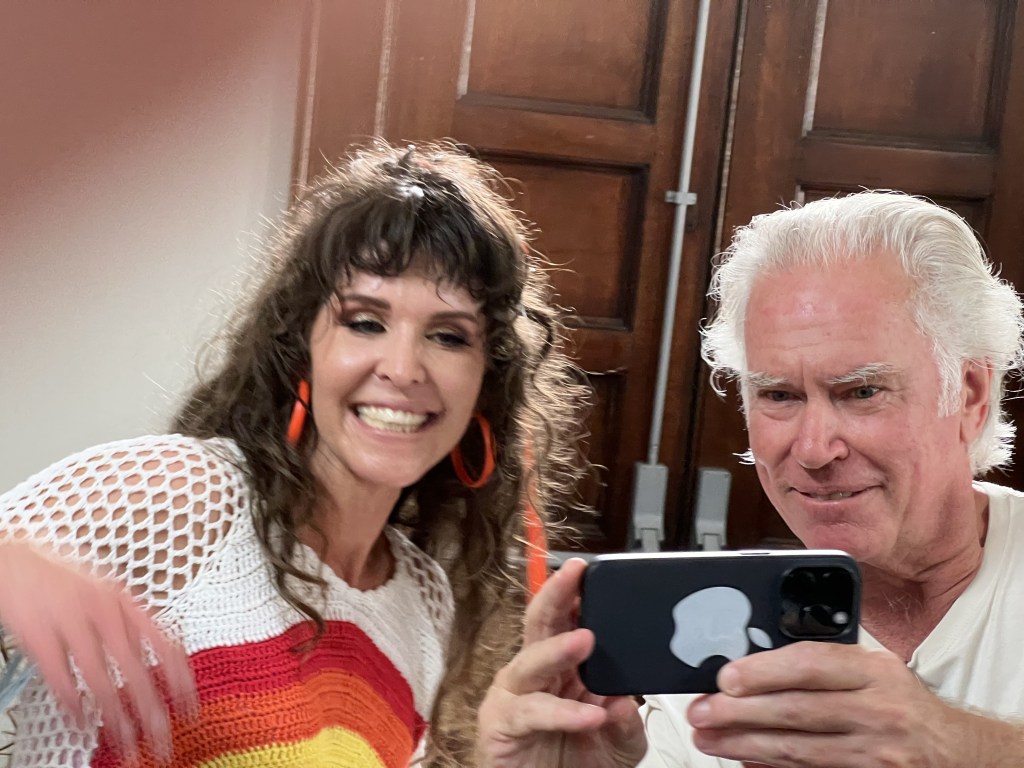
fanny’s a farm girl from tooma, a tiny community 600km from the nearest city, and she connected with the farm families who filled the hall from the moment she pranced onto the stage. afterward, home girl fanny (who was born margaret edwina lumsden) led fans to the back of the hall where she posed for selfies and signed autographs until the last fan had gone.

fanny-fan selfie

later that night, at the “golden guitar” awards ceremony, fanny won for best album of the year. she got a standing ovation from the fans at TRECC. later this year, we hear, she and the prawnstars are touring the u.s. (keep an eye out, americans. you’re in for a real treat)

the next day, tamworth rolled up the signs, the artists packed up their gear, and the fans melted back into their daily lives ploughing the red earth in outback australia, west of the great divide. bush country.

until next year.

-30-

free assange- an old time ’70s protest

a few hardy australians turn out to support an imprisoned native son

the demonstration was right out of the 70s. in fact, most of the tiny crowd appeared to be in their 70s, relics of an earlier age when long-haired protestors railed against a long-ago war. and if attendance was a bit on the short (as in “almost non-existent”) side, it could have been because most of the demonstrators were long dead.

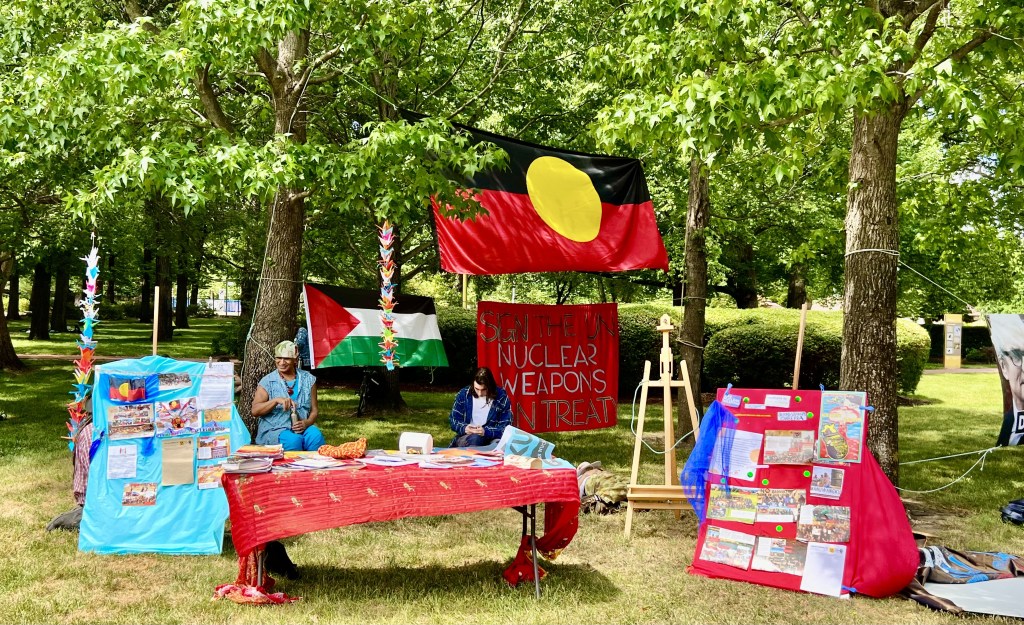
the “free assange” rally in canberra draws a small crowd

that didn’t stop the remaining faithful, all few dozen of them, from gathering at canberra’s glebe park on a gorgeous spring sunday afternoon to shout into the empty fields. kicking off the festivities, a white-haired guitarist growled the words to barry mcguire’s 1970s anti-war song “eve of distraction destruction” to an audience of four people singing along in front of a portable stage littered with protest signs. might’ve been his wife and grandkids.

what the demonstration lacked in bodies, it made up for with signs. it was like the old 1970s rock anthem.

signs, signs, everywhere signs.
blocking out the scenery,
breaking my mind.
do this! don’t do that!
can’t you read the signs?

FIVE MAN ELECTRICAL BAND–1971

there were billboards everywhere around the park, more signs than people. no nukes signs, anti-war signs, posters supporting whistleblowers and whistleblowing, misspelled signs, palestinian flags, indigenous australian flags, and “free assange” literature. but no one to read them.

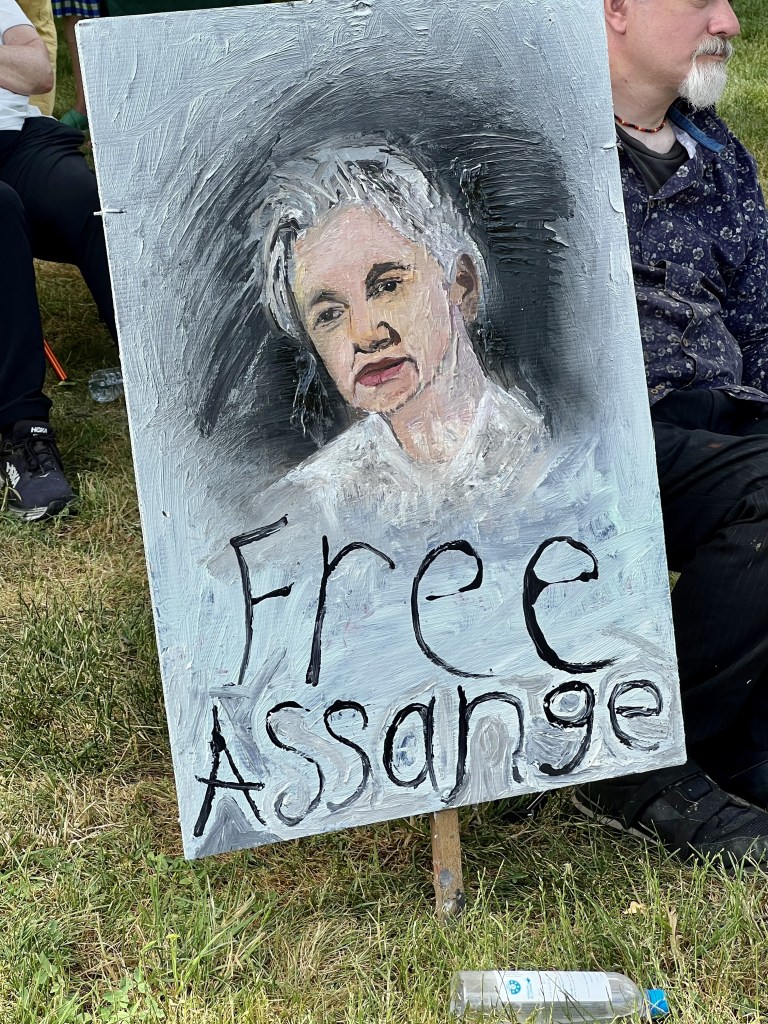
an artist displsays his hand-painted portrait

being a journalist, the “free assange” theme had attracted me. assange is the the australian founder of wikileaks, a website that specialized in releasing classified documents from intelligence agencies. he’s currently in britain’s high security belmarsh prison awaiting extradition to the united states to face charges of publishing “secret” documents that revealed nefarious (read illegal) activity by the CIA.

but there were other causes vying for attention. “free david mc bride” was a popular one. mc bride, apparently a military whistleblower , was in attendance, followed around by a camera crew. mc bride was facing a court hearing the following day on charges of violating australian state secrecy laws that could carry a sentence of several years in prison. he was a bit of a folk hero among the assemblage, posing for pictures, and hugging and kissing the women. not an enviable task.

david mc bride greets a supporter

remarkably, the lack of an audience didn’t seem to deter the rally. a procession of speakers and mostly one-man bands crossed the stage, each acting as if the house were full of cheering supporters. applause even broke out a few times, though probably not enough to register on the applause meter. and when the call went out from the stage that sausages were ready on the barbeque , there was a noticeable shift of humanity toward the grill. p.s. the vegetarian sausages were mighty tasty.

the moral of the story is: if you’re going to hold an anti-government demonstration, don’t do it in a government town. the capital region was the only jurisdiction in australia to vote “yes” for the recent referendum on whether to give indigenous australians an extraconstitutional “voice” on matters of interest to them. overall, the referendum lost by a 40-60 margin, and it failed in every state. but in the capital territory it passed handily.

the assange case is now likely to move to the u.s., where it faces an uncertain future. wikileaks has never been popular in the american press, and the biden administration is bent on cracking down on whistleblowers, especially those who expose the secrets of the national security establishment. former president donald trump had promised to pardon the aussie wikileaks founder, but apparently got cold feet in the tumultuous last few days of his presidency. “free assange” may remain a rallying cry of the antiestablishment crowd for some time to come.

-30-

quintessentially aussie — kangaroos, koalas and the opera house

a golden tribute to australia’s iconic architectural wonder

the laser lighted sydney opera house on its 50th birthday. AAP Image/Dan Himbrechts

“it is the symbol of modern australia. it’s the most recognized thing… internationally, apart from the kangaroo and the koala, and the most loved.”

those words, spoken by louise herron, CEO of the sydney opera house, perhaps said it best. speaking to australia’s ABC radio, herron called danish architect jorn utzon’s architectural masterpiece “the image of australia to the world”, (except for kangaroos and koalas).

fifty years to the day after the magnificent performing arts center opened its doors on a promontory jutting out over sydney harbor, utzon was well remembered. it’s been more than half a century since local politicians and bureaucrats harrassed him and eventually ran him off in disputes over cost overrruns. time has shown that his insistence on spending that extra dollar (or tens of millions of dollars) to fulfill his extravagant vision of a world class opera house has been more than vindicated.

utzon went back to denmark and vowed never to return to australia after his unpleasant experience. he died without seeing his creation in person. but his eldest son and daughter, jan and lin utzon, were honored guests at a golden anniversary extravaganza the opera house hosted for sydney’s cultural illuminati. (i.e. the folks who keep the lights on and pay the bills). as the price of admittance, attendees all wore (at least) a touch of gold.

the anniversary also provided a golden opportunity to tally up the value sydney has received for the US$102 million dollar investment it made in australia’s culture back in the mid-20th century. can its value even be quantified?

david redhill has been following the evolution of “the house” since he witnessed its opening as a teenager. years later, the adult redhill became a consultant with the international business advisory firm deloitte, where he remembered the grand opening and contemplated the question of what the expenditure that had seemed so large in 1973 had become in current dollar. in other words, what was the return on investment that sydney and australia had received from the opera house. after discussing the question of the house’s value with CEO louise herron at the 40th anniversary celebration in 2013, redhill developed a complex mathematical framework for longitudinally tracking the financial impact of herron’s development program for the house — what it had gained in terms of the sydney’s and australia’s role and reputation, not just domestically, but in the international arts community. ten years ago, the formula yielded a valuation of US$4.6 billion. using the same metrics today, redhill calculates the current value at US$11.4 billion. and that’s not counting its brand value.

“whatever the total income it generates directly,” redhill wrote, “it’s obvious that the opera house is worth more in the minds and hearts of australians. its pre-eminent value is social, and its brand is peerless.”

that article containing its lofty valuation was enough to get redhill and his wife amanda invited to herron’s backstage birthday party, where he could be seen wearing “a touch” of gold. some other invitees may have overdone it on the gold theme.

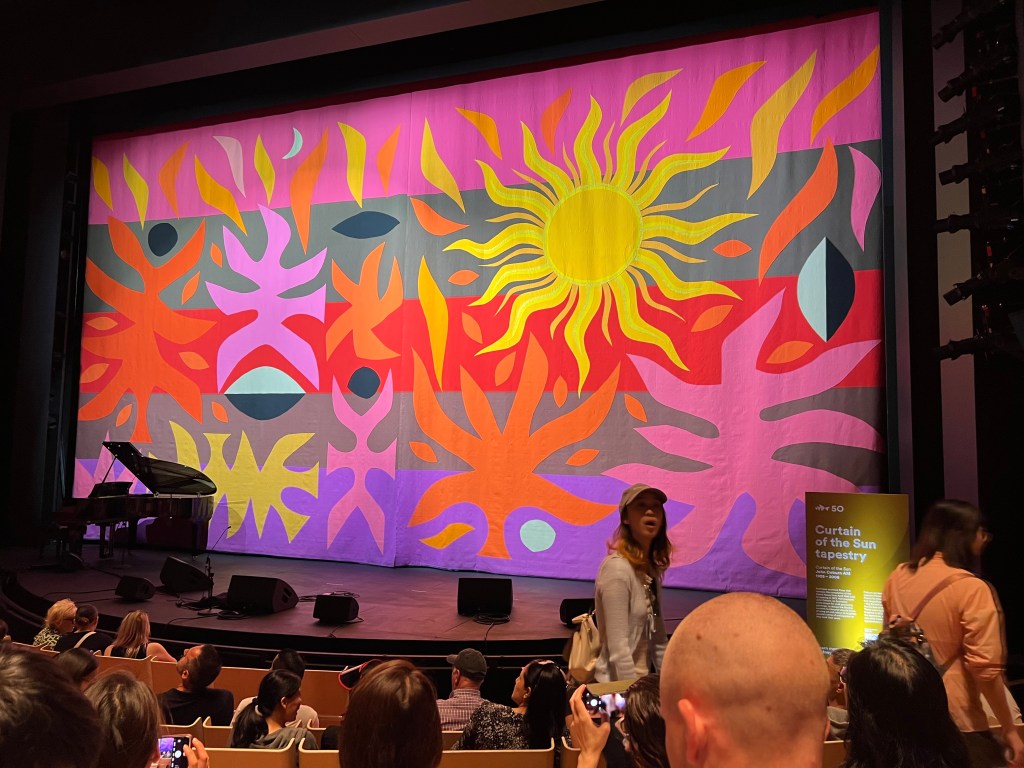
among the extremists was steve coburn, son of john coburn, the artist who created the exotic “curtain of the sun” tapestry that was on display in the joan sutherland theater for the weekend’s festivities.

jan utzon,(center) eldest son of opera house architect jorn utzon, flanked by steve (left) and daniel (right) coburn, sons of john coburn, who created the “curtain of the sun”. that graced the main stage for the occasion.

steve came outfitted in yellow pants, an eye popping yellow paisley sports coat, and a lemon yellow hatband. that outfit might have been considered a faux pas at many of sydney’s high society functions, but was perfectly de rigueur at this golden-hearted celebration. (see picture above).

“curtain of the sun” tapestry by john coburn

for the 400 invited “golden guests”, it was a night to remember.

let it not be said, however, that the rest of australia was ignored by the party’s planners. this is the people’s house, after all, and the entire complex was open to the public for the remainder of the birthday weekend. an estimated 37,000 free-ticketed visitors paraded through the concert halls, serenaded along their journey by musicians playing mini-concerts …

visitors stroll through the joan sutherland theater as musicians perform onstage.

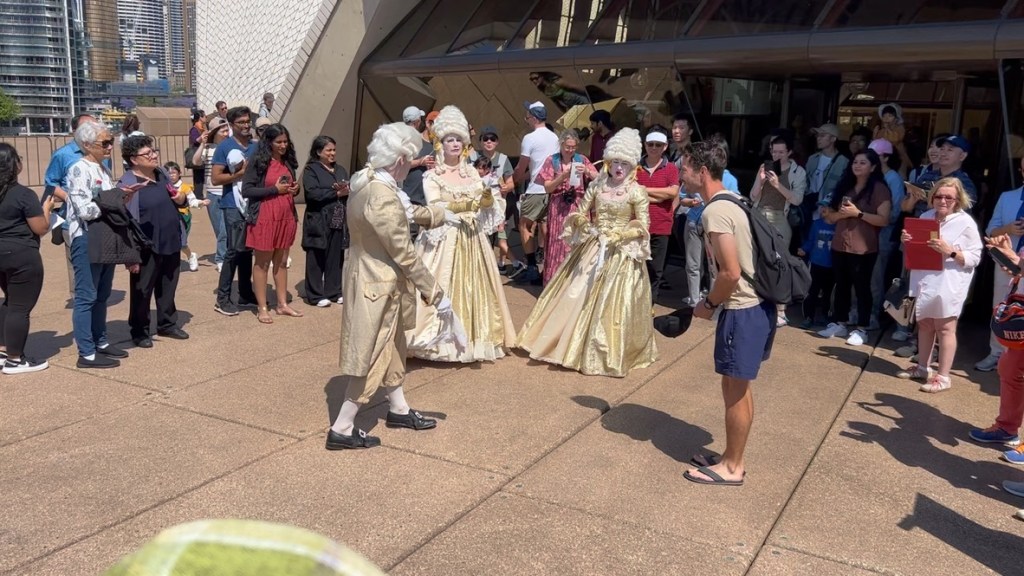
some non-musical performers also got in the act, performing dance scenes from famous 18th century operas on the concourse overlooking sydney harbor.

the birthday celebration made headlines the world over, with news outlets in several countries adding stories of their citizens’ contribution to the construction of “the house”. the irish times newspaper capped its coverage with a sidebar about an irishman (irishperson?) whose engineering skills were instrumental in creating the sail-like (but challenging to construct) roof panels.

The Irishman and structural engineer Peter Rice played a central role in creating the revolutionary modern structure, using his mathematical expertise and artistic intuition to convert concrete, steel, and glass into the world-renowned white sails roof structure.

(tip o’the hat to trish mc carthy, spouse of the irish ambassador to australia, for spotting that article)

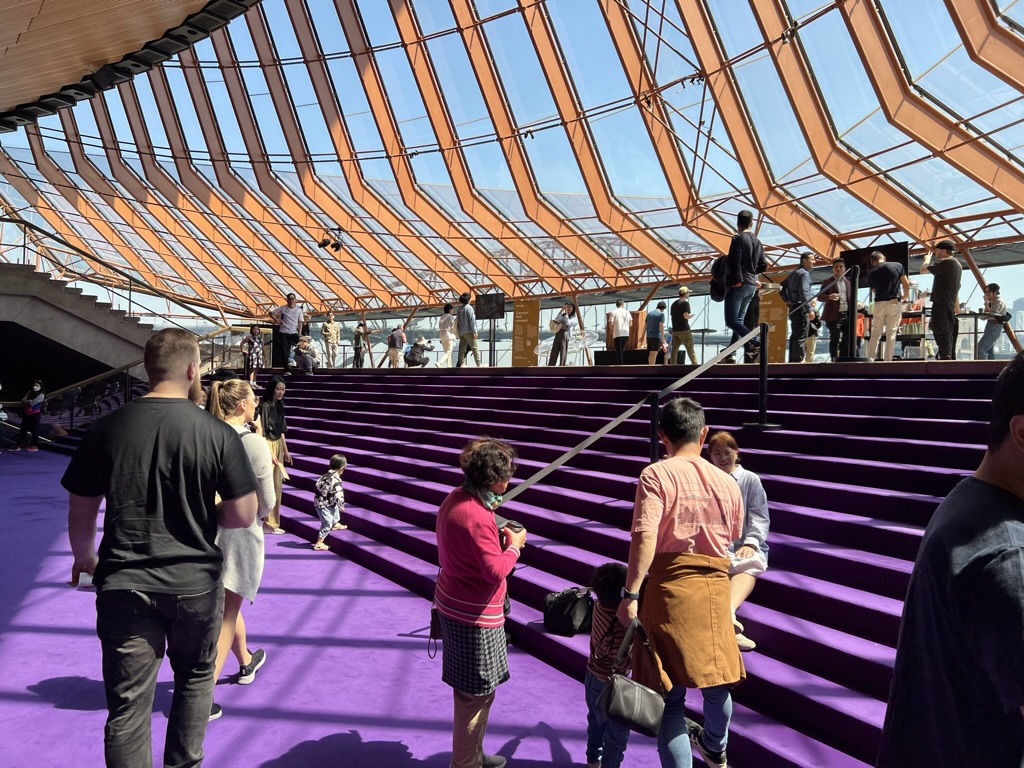
visitors used to seeing the familiar white sails of the opera house exterior were treated to the view from the inside out — almost as stunning.

looking outward from the opera house toward the sydney harbor bridge (in background)

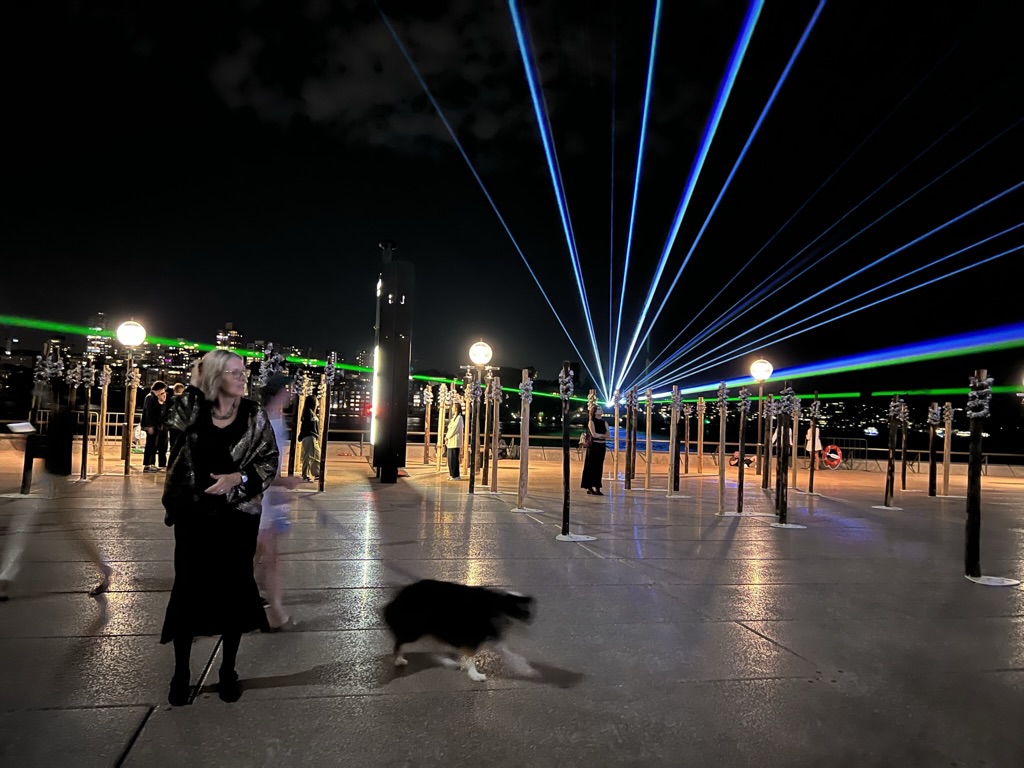
and while, on the night of the anniversary, viewers from across the water had the unparalleled view of the laser-lighted opera house pictured at the top of this post, partygoers at the birthday celebration had the opposite perspective; spectacular in a different light.

the danish ambassador views the laser light show from the opera house concourse

too bad they only do these big 50 year birthday parties every half century or so. we can’t wait for the next one, if only to see if the opera house will have displaced kangaroos and koalas to become #1 in the minds and hearts of australians. from a financial standpoint, it’s already a no-brainer. for an investment of US$102 million, sydney now has $11.4 billion (with a B) in value, and as analyst david redhill’s value survey revealed,

“…three aussie icons stand head and shoulders above all others as quintessentially australian and universally loved; the koala, the kangaroo and the sydney opera house. no other human-built creation even comes close.

so to jorn utzon (RIP wherever you are), please remember: the penny-pinching bureaucrats and politicians who ran you off in a dispute over minor details may have won the battle of that day, but half a century on, the evidence is clear. your vision has, and will, endure. $11.4 billion worth (at least), and counting!

-30-