and a guest appearance by none other than big bird
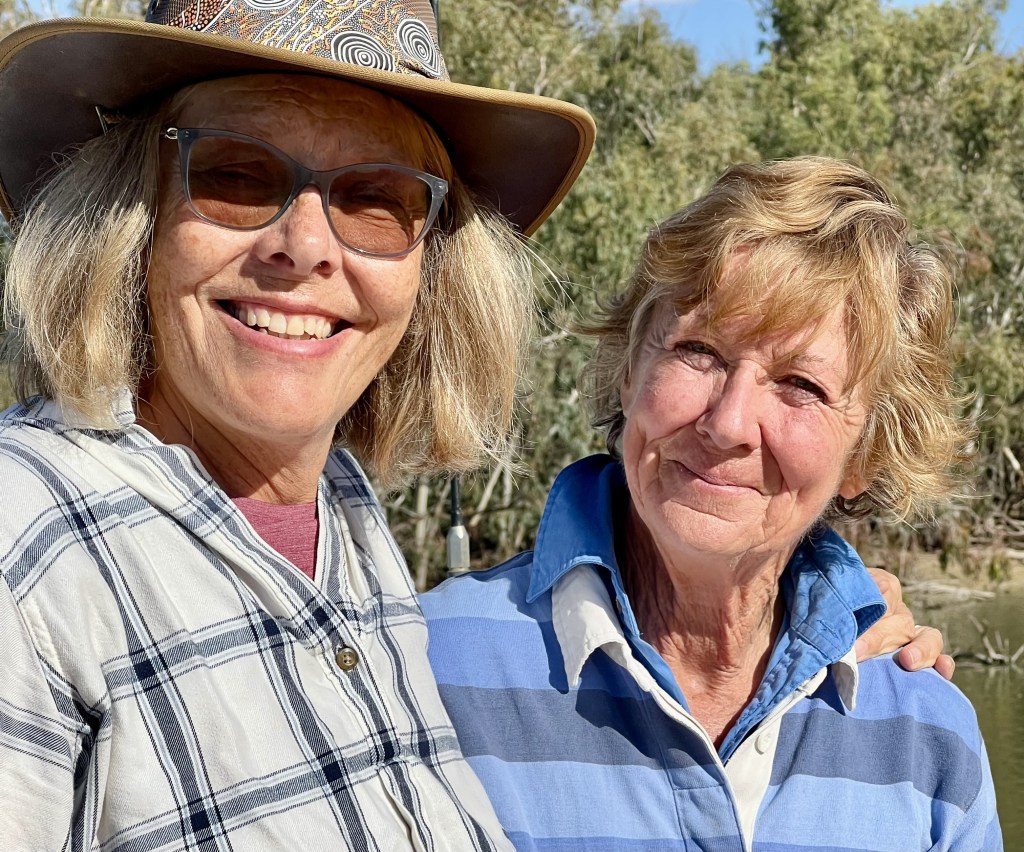
lip to lip and hat to hat. what kind of an anniversary kiss is that?
back home in the u.s., we’re imperial. we do milestones. here in oz, they’re metric, hence kilometerstones.
so it is that we’ve come to the rainforests of northern queensland in early september to celebrate a passel of kilometerstones. they’re sorta like kidney stones, but they hurt less when they pass. and we passed a large round one this time. the big three-oh anniversary. so guess what we did for the occasion? we passed another one! pernille’s 500th aussie bird!
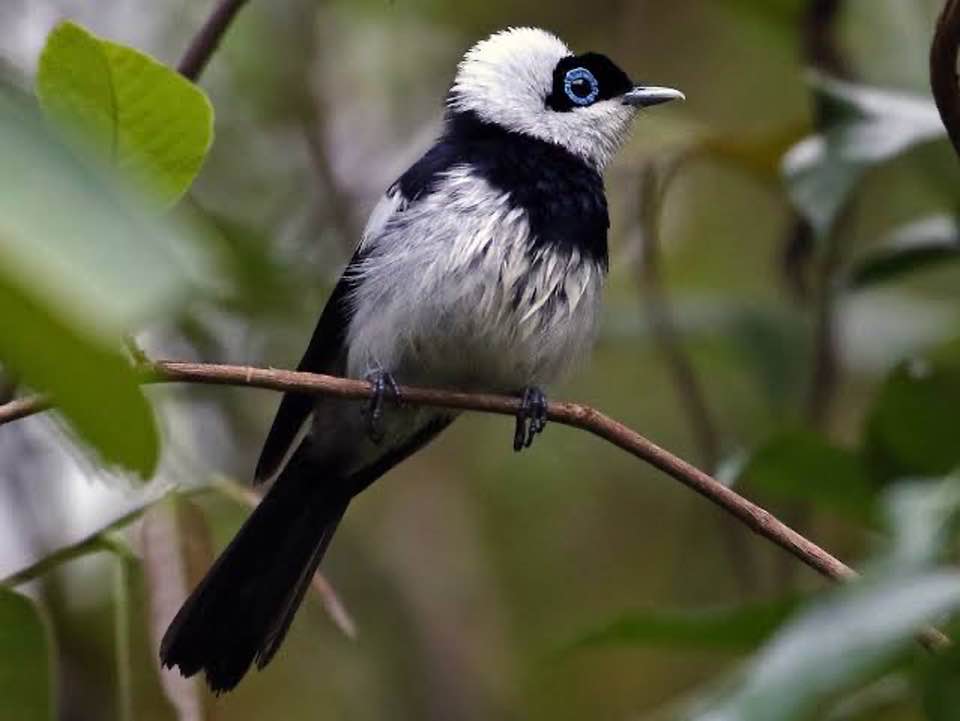
pied monarch: photo courtesy e-bird
it was a pied monarch, not a rare bird like the fabled cassowary, the big (5’6″ tall) emu-like fowl that inhabits this part of the world, but a winged creature of the aussie variety nevertheless, the 500th different species pernille has spotted in three years — minus four days — in australia.
when we arrived in canberra in early september, 2020 (during the covid lockdown, remember that?) pernille set herself three goals for our presumed four year stay here. two were professional. she’s achieved one and is on track for the other. but the third was to spot 500 different bird species. it seemed like a pipe dream at the time. but she’s achieved the goal four days before we’ve been in oz three years. and on our 30th wedding anniversary to boot; that’s quite a coincidence.
from daintree, where she spotted the pied monarch, it’s on to cape tribulation, the northernmost point on our itinerary, and the hunt for the storied southern cassowary. there are said to be fewer than a thousand southern cassowaries in existence, all within a few hundred square kilometers in the tropical rainforests along the north queensland coast. this is a quest.
so, how to find one? cassowaries are known to be reclusive and aggressive. they have a reputation for attacking anyone who gets too close, and they can kick with both feet at once, delivering a painful, sometimes fatal blow with their powerful horned claws. binoculars are recommended for spotting them, even though these birds are as tall as humans.
we heard from locals that there had been some recent cassowary sightings out by emmagen creek crossing, seven kilometers north of cape tribulation, and the best time to see them would be early morning. so we dragged ourselves out of dreamland at dawn and headed north.
a perky sun was peeking over the treetops when we arrived at emmagen crossing. as we parked our SUV, the silence of the rainforest was broken by the splash of another four-wheel drive vehicle fording the two-foot deep stream toward cooktown, 100km up the unpaved road. from then on, we were enveloped in silence, broken only by the faint burble of the stream lazily wending its way to the coral sea half a kilometer away. it was just the two of us, alone in the dappled sunlight of a jungly early spring morning, waiting for a rendezvous with…big bird.
an hour passed. we camped on a tree root on the creek bank, trading glances. nothing. losing patience, we decided to ford the stream ourselves and see what might be on the northern side. there we found a few ‘cassowary trails’, little paths through the jungly underbrush that looked as if they had been formed by foraging cassowaries, but there was no sign of bird life. just an ominous silence. so we turned around and crossed back to the south side of the creek, destination home. defeated.
about a kilometer past the creek, i had a hunch. we parked the SUV alongside the road at the entrance to a small trail and set off on foot into the jungly underbrush. the going was slow in the dimly-lit forest, but we pushed on toward the coastline we knew had to be close by. as we approached a small clearing, i looked to my right and behold!! i found myself staring face to face with an adult southern cassowary. his bushy blue bulbous body was standing in the brush not 25 or 30 feet (8-10 meters) away. he seemed to be as startled as we were at the encounter, and stood motionless, as did we. when i regained my composure, i slowly raised my new canon power shot camera and clicked off a few frames. they were mediocre because a) the dense undergrowth confuses the camera’s autofocus feature so the focus was soft, and b) not much sun makes it down through the jungle to the rainforest floor so the light was less than optimal.
cassowary in the rainforest
nevertheless, mr. cassowary was kind enough to pose for one full-frontal face shot before we decided not to test our luck any further and tiptoed away toward the beach, which proved to be no more than 150 meters further down the path.
cassowary, taken with my new canon power shot SX 70 HS
when we returned ten minutes later, mr. cassowary was gone. we could see him moving in the distance, but there was no need to trouble him further. thank you, kind sir, for that chance encounter.
after that, everything else was anticlimactic, including a birthday celebration, not a round one like our anniversary but a crooked one like the pair of crutches that seems inevitable as we age.
by the time our queensland holiday came to an end, pernille’s bird total was well above 500, though most of them evaded the gaze of the new canon camera. but after 500, who’s counting? australia has some 950 individual bird species. who’s to say we won’t see ’em all. but none will be as memorable as mr. cassowary.
they say the world cup competition is for losers. thirty-two teams compete, 31 lose. one–spain in this case– takes the cup and goes home for four years. the 2023 pageant was held “down undah”, in australia and new zealand. it’s the first time the competition has been co-hosted by two countries. too bad only one could win.
the previous two women’s world cups had been won by the u.s., as the rest of the world’s women caught up. but the catching up is done, and the americans’ moment is over. the “red, white and blue” barely survived the group stage this time, and made an unceremonious exit in the first knockout round, denying megan rapinoe and company a fond farewell from the competition they dominated for the past decade or so. now it’s the spanish womens’ turn to rule. this year the spaniards won the world’s under 18 competition, the under 21 tournament, and now the big one — the women’s world cup.
“travel soccer” is a term many moms and dads learn when their kids try out for the neighborhood team. the coach of the team then enrolls them in a league where they go to the home fields of other teams to play their matches. so parents usually wind up spending their weekends carting their beloved offspring to farflung neighborhoods to watch them chase around a soccer ball. in a country the size of australia, traveling to see your team’s world cup matches can mean splurging the family fortune on transcontinental air fares and winding up with a bad case of jet lag.
and so it was.
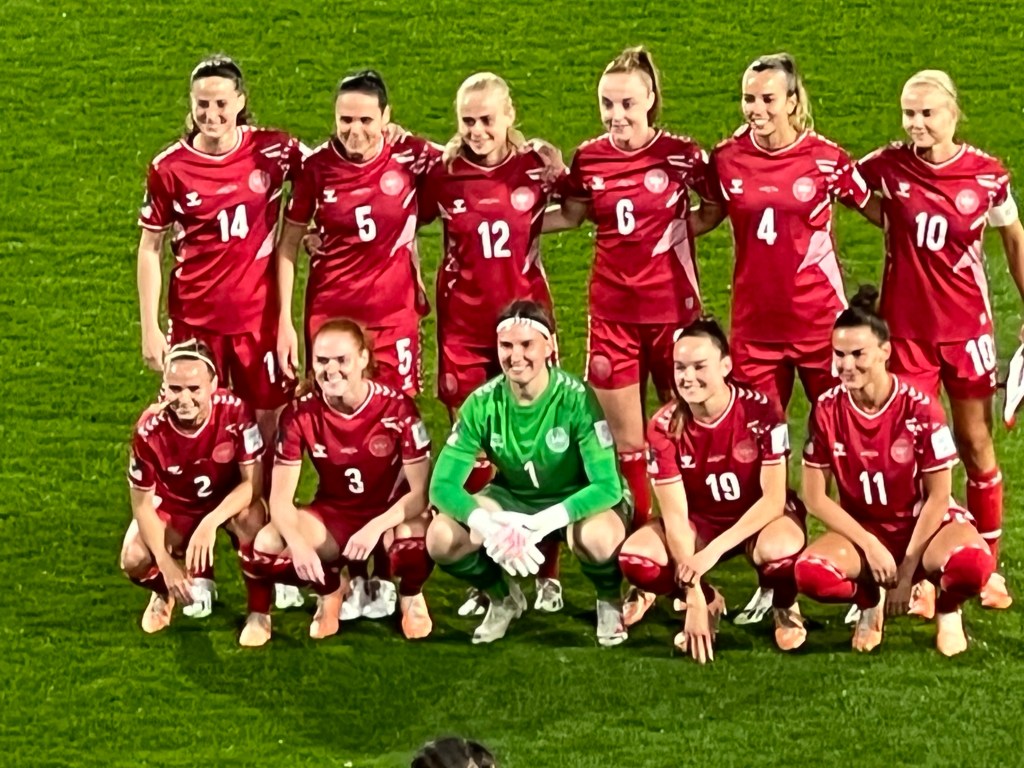
the danish women didn’t really have a chance to win the title in this women’s cup 2023 competition. but who cares? the object is to have some fun, root for your team and country, travel a bit (in this case, a lot!) and pay qantas (the airline) a few more bucks you didn’t have in the first place.
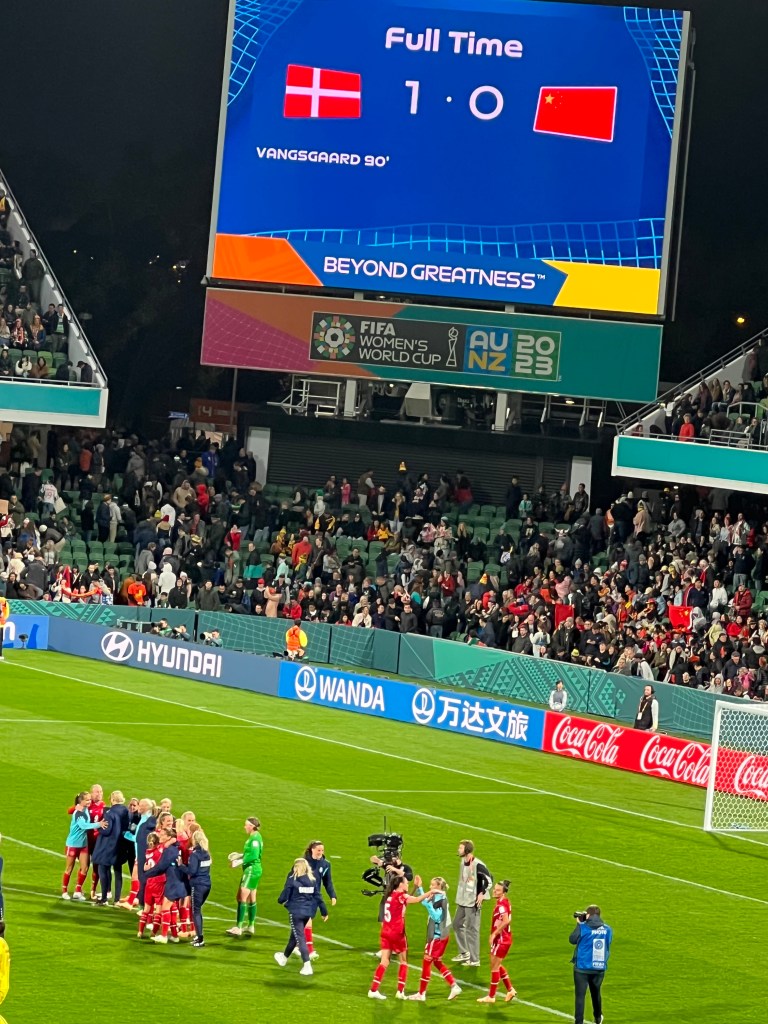
fortunately, (i suppose) denmark’s matches were all in australia, but oz is a big place, and we were following the women in red to the match sites. first perth, on australia’s southwest coast, where the danes played their opening match against china. it was a slow contest, though not nearly as time consuming as the 4 ½ hour flight from canberra to perth.
denmark finally scored a goal in the 90th (last) minute of regulation time to defeat the chinese women and secure the three points that went with it. so much for excitement.
a goal in the 90th minute separated denmark and china
among the highlights for us was a meeting with two danish fans who were reunited for an 81st birthday celebration, several decades after one of them relocated from denmark to australia. sadly, we don’t have “before and after” pictures showing how little they’ve changed over the years (or not).
the “after” shot of 2 danish “ladies in their 80s” reunited in oz after decades on opposite sides of the globe.
the second “group stage” match was on the other (eastern) edge of the continent, against england, requiring another transcontinental (read five hour) flight to sydney. england was one of the ranked teams in the competition, boasting several players from the english women’s premier league. the lionesses, as the english women are known, were a class above the danes, scoring a goal early (from chelsea striker lauren james), then holding on to that for a margin that held up all night. three points for the limeys.
then the team flew back to perth again, this time to face haiti, their third group foe. it was too much for us. we watched on TV. another single goal against the haitians was enough to garner three more points, getting the danes to six (three points per victory, one for a draw). that result, coupled with a monster english victory over china, was enough to see denmark through to the round of 16, the knockout stage. three matches, two goals.
next opponent, however, was australia, in the first knockout round. facing the matildas, (from ‘waltzing matilda”, the national song), the tournament’s home team, was a daunting task under any circumstances. for the danes, playing in front of a sea of yellow shirted crazies at sydney’s 80-thousand seat olympic stadium proved an insurmountable challenge.
pernille’s red and white clashes with australia’s green and gold opera house
sydney was all decked out for the denmark match, with the (danish designed) sydney opera house dressed in australia’s green and gold for the event.
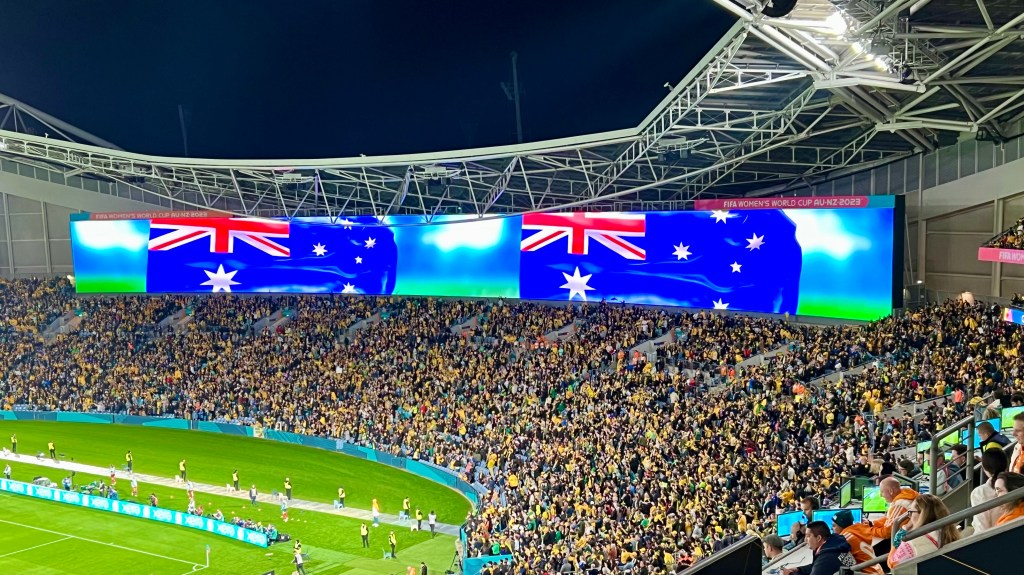
in the end, the danes total of two goals in four games was just not good enough. aussie striker caitlin foord, who plays club football for arsenal (my team) in the english premier league, scored an easy first half goal in a one-on-one matchup against denmark’s goalkeeper, and the danes were never a real threat to score. the matildas cruised, 2-0 (two-nil).
a double aussie flag celebrates one (or both) of the matildas’ goals against denmark
so much for travel soccer. the knockout stages are “win or go home” affairs, so it’s back to copenhagen for the red shirts, and an “end to the spend” on air fares. in the end the big fish (england & eventual winner spain) were left to battle it out for the cup. it was (extravagant) fun for us minnows in the world cup pond while it lasted, but there’s an end to every cinderella dream, and the clock has struck midnight. we’re pumpkins again.
p.s. on a sad note, it emerges that spain’s winning goal-scorer in the final, olga carmona, learned after the match that her father had passed away earlier in the day. the news had been withheld from her so as not to distract her during match preparations.
australia’s bush country shows off its cultural attributes
the odometer reads 24,200km when the land rover sloshes out the gates of bindara farmstead into the sea of red mud leading to the mining town of broken hill. broken hill is “week 2, stop 1” on a three-week journey through the near reaches of the great australian outback. it hadn’t been planned that way, but the rain gods had forced cancellation of a stop in white cliffs, where we had been promised a room in an underground hotel. underground rooms don’t sound so delectable in a mud pond.
it’s been three days since a daylong downpour brought bush travel to a standstill in much of northwestern new south wales, stranding us at the bindara farmstead on the banks of the darling river. it’s ok, though. we had planned to spend three nights at bindara anyway, so the rainwater that flummoxed other travelers was actually well-timed for us. but now the hour of truth has arrived. can we navigate 60km of mud between us and sealed road?
our host at bindara, barb, has been consulting with friends and neighbors to get the latest on road conditions, and she’s fairly confident we can make it in our four-wheel drive vehicle if we’re cautious.
it’s a sunny morning, june 8th, as the land rover pulls out into the bush mush. despite the concerns of the locals, the wagon ploughs along the track quite efficiently, and we traverse the mud red sea at 25 to 35 km an hour, with occasional hiccups where puddles overtake the roadway.
broken hill is a pleasant surprise. we had listened to the talking heads from the tv networks in sydney or melbourne telling how miserable life is in outback mining communities. our tv news picture was of a lawless frontier town run amok with unemployed, wheezing miners aimlessly wandering the streets with no ambition, little respect for authority, and a worrisome dependency on australia’s famed “nanny state” for social services.
it’s a pile of rubbish, this tale of woe. sure, broken hill’s most eloquent structure is its miners memorial, dedicated to the hundreds of men and boys who died laboring in inhumane conditions in dimly lit shafts. the memorial tells the story of a 12-year old boy who fell to his death down a mine shaft, and of others electrocuted when they touched high-voltage power cables in the inky blackness.
And yes, the homes in broken hill tell a tale of hardship. many houses are rudimentary shanties that provided little more than a roof and a wood stove to come home to after a 16-hour day breathing noxious fumes in a hot, dark, poorly ventilated trench. But broken hill holds its head high, boasting of its accomplishments on behalf of its labor force. It’s a proud union town where people share a bond of backbreaking toil and trouble. to their credit, broken hill is a monument to their hard-won victory over the elements and the giant mining corporations that exploited the workers’ vulnerabilities to make their owners rich. broken hill reveres a hard day’s work and celebrates the indomitable human spirit.
Since we were a day early, our hotel at the imperial in broken hill was already booked for the night. Instead we stayed across the street at a budget motel. next morning we arose, immediately grabbed our things and drove across the road, (a distance of less than 100 meters), to the imperial, probably overpriced but a throwback to broken hill’s glory era. the town had its heyday more than a century ago, when the land baron sydney kidman controlled much of the outback and the sheep shearing stations were magnets for itinerant immigrants willing to take any job they could find to earn a subsistence wage. sound familiar, america?
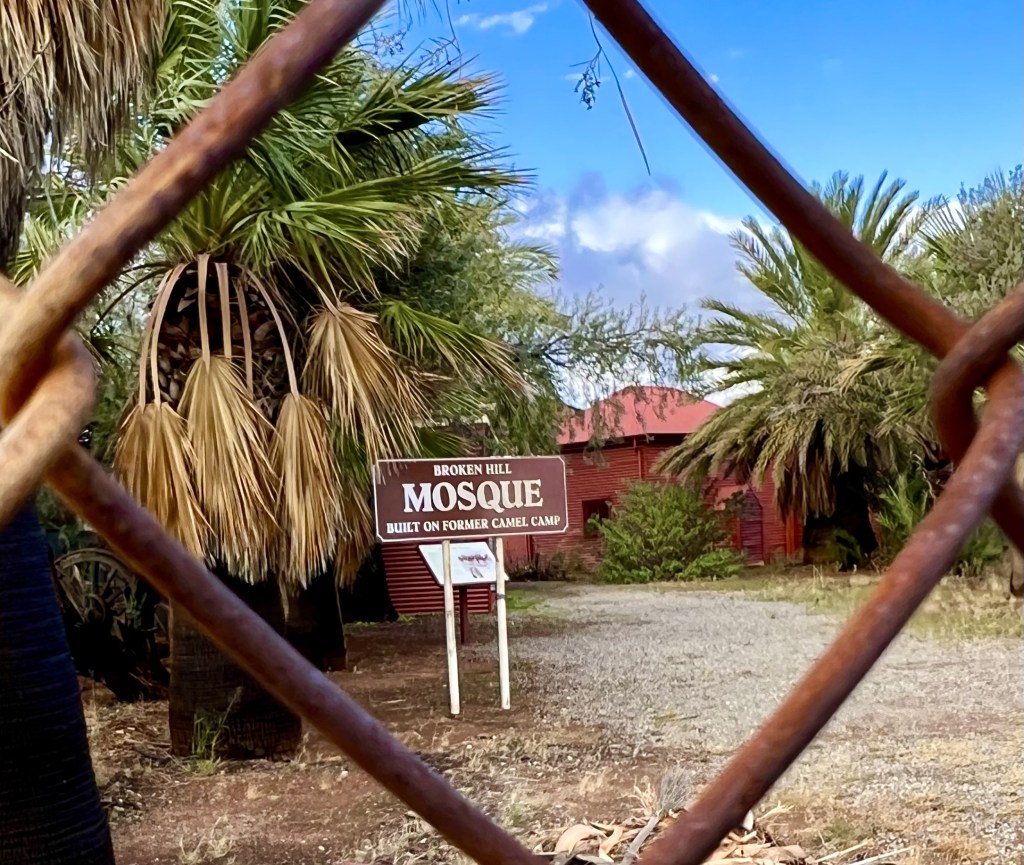
broken hill is the largest town we’ve seen since we left canberra. and just as in the capital, where we live across the street from the canberra mosque, one of the first things we encounter while exploring broken hill is the city mosque.
the gate is open, so we park and walk in, where to our surprise, a TV crew from ABC Sydney (australian broadcasting corporation) is just completing an interview with a mosque official. The official, it turns out, is a grandson of shawrose (probably transliterated from shahroz) khan, one of the original afghan “cameleers” who led the camel caravans that transported to market much of the wool on which the outback economy was built. we hadn’t known.
a little homework reveals that australia’s leaders were flummoxed in implementing their racist “white australia” policy as the nation prepared for federation in 1901 because, surprise, many of the “asiatics” they hoped to exclude from the country were in fact british subjects, just like them. (in those days, remember, the sun never set on the british empire.) that didn’t fully stop the white fellas from implementing their devious scheme, but it sure gave them fits as they attempted to pass legislation that would achieve their goal of keeping the brown fellas out without alerting the crown back in London to their intentions.
broken hill’s CBD (central business district) is an eclectic mix of the 19th, 20th and 21st centuries. people order food on the cellphone apps, while at the palace hotel on argent street, the town’s main thoroughfare, floor-to-ceiling murals depict a 19th century miner’s world where any food at all would have been welcome. argent street is a veritable modern shopping mall several blocks long featuring enticing stores and eateries reflecting the town’s ethnic diversity. among the attractions, we find the broken hill national park information center, where a delightful woman behind the counter (we forgot to ask her name, but we took her picture) spent many minutes going over with us the regional maps and info sheets that explain the historical and geological significance of far western new south wales and vicinity.
a volunteer explains the wonders of the national parks in far northwestern new south wales
for all intents and purposes, broken hill is a city, not just an outback town. It sports a restaurant/pub district where you can enjoy fine dining (or drinking) with an excellent wine list featuring vintages from bordeaux or napa valley; or if your tastebuds are discerning and your palate more chauvinistic, maybe a bottle from margaret river in west australia, or mclarens vale in south australia. they’re all excellent. we chose beer.
but broken hill’s real secret is its art. mining art is, at first blush, an oxymoron, sort of like military intelligence, but the raw beauty of the region has attracted some discerning eyes able to see beyond the jackhammers and the saltbush to the magical sunsets and the pioneer spirit that compelled its founders to put down roots here.
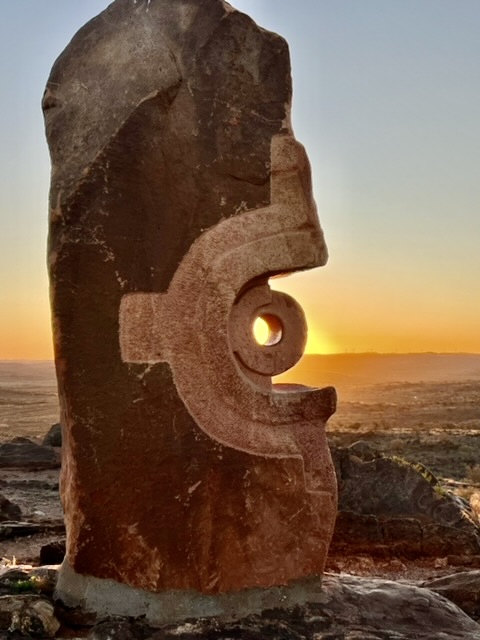
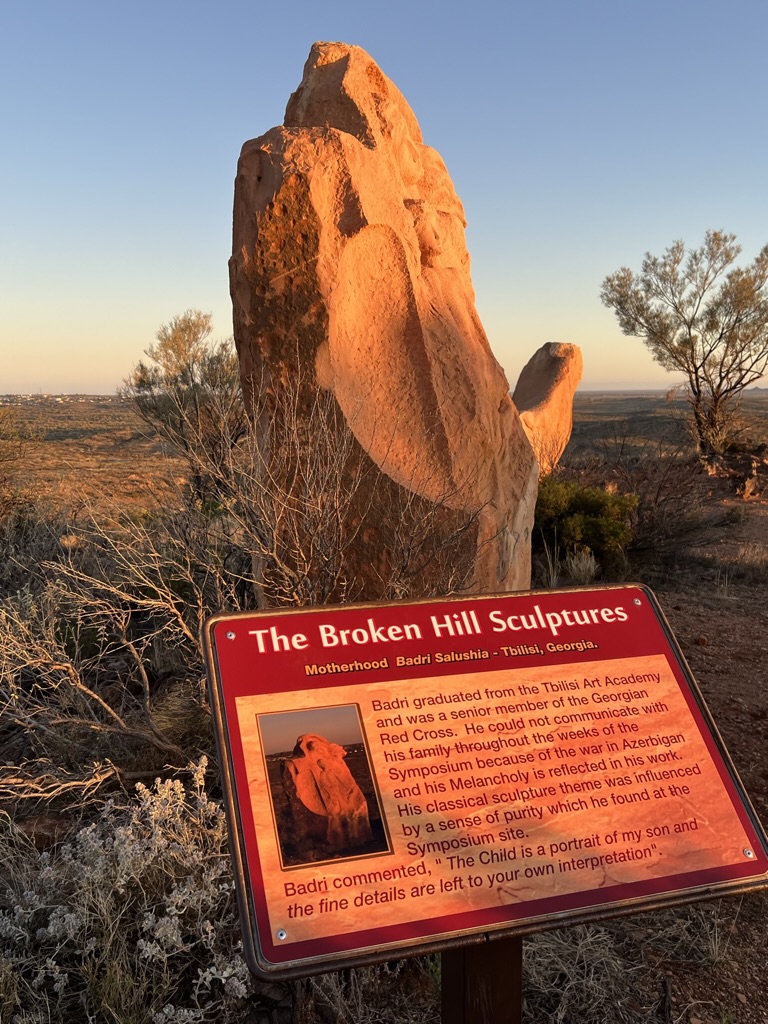
“broken hill sculptures” is an example. It’s located at living desert state park, several miles (kilometers) out of town on an expanse of red hills that glow at sunset.
Each evening, as shadows fall over the saltbush and spinifex grass , locals and tourists alike gather in the sculpture garden to photograph a collection of fine art crafted by master sculptors from across the planet.
the signature work at broken hill sculptures
meanwhile, on a suburban street back in town, the pro hart gallery attracts a steady stream of tourists to view artist kevin charles “pro” hart’s scenes of life in 19th century outback australia.
We couldn’t help picking up a souvenir or two while there. Maybe a christmas gift for some lucky person.
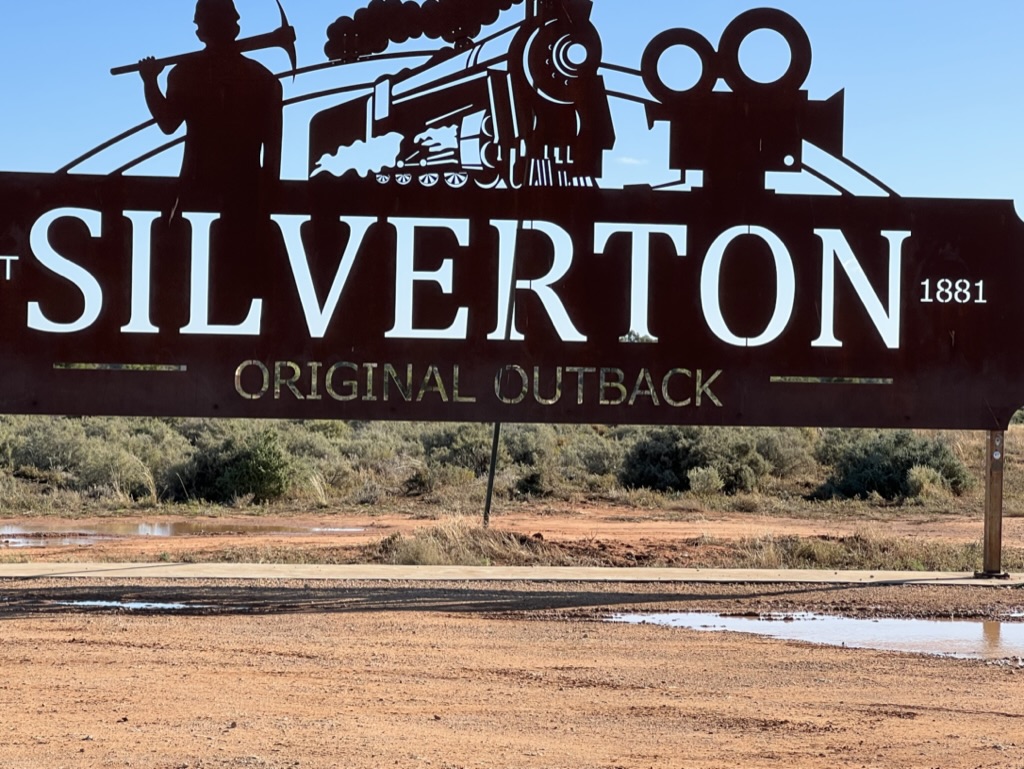
from broken hill, it’s worth a day trip to the mining village of silverton about 30km to the west. silverton is little more than a pub, a souvenir shop (art gallery) and cafe. it’s supposed to be where the “mad max” movies are made, but i can’t vouch for that. it’s authentic, though. it really was a gold rush boom town in the mid-19th century outback. it makes an impression, right down to the gaol (jail) museum that illuminates the life of wild west ne’er do well prospector/criminals paying the price for their crimes, as well as the jailers who kept watch over them. anyone contemplating a life of crime should visit the silverton gaol museum. It’ll scare the be-jeezus out of you.
From broken hill, the road northward leads to tibooburra , via the sackpaddle roadhouse. sackpaddle, sometimes also known as packsaddle, is basically a roadside pub where you can get a bed, buy souvenir t-shirts and top up your tank. suckers that we are, we bought a couple t-shirts. $58 a pop, but hard to get elsewhere. “we’re the only game in town” the clerk told us. she was wrong. there’s no town.
tibooburra may be the antithesis of broken hill, a spot on the map without any apparent reason for existing. it’s simply a curve in the road near the entrance to an out of the way national park, where some godforsaken souls have erected a service station and a hotel/motel/pub. We’re booked for three nights there. pernille’s been told it’s a great place for birding.
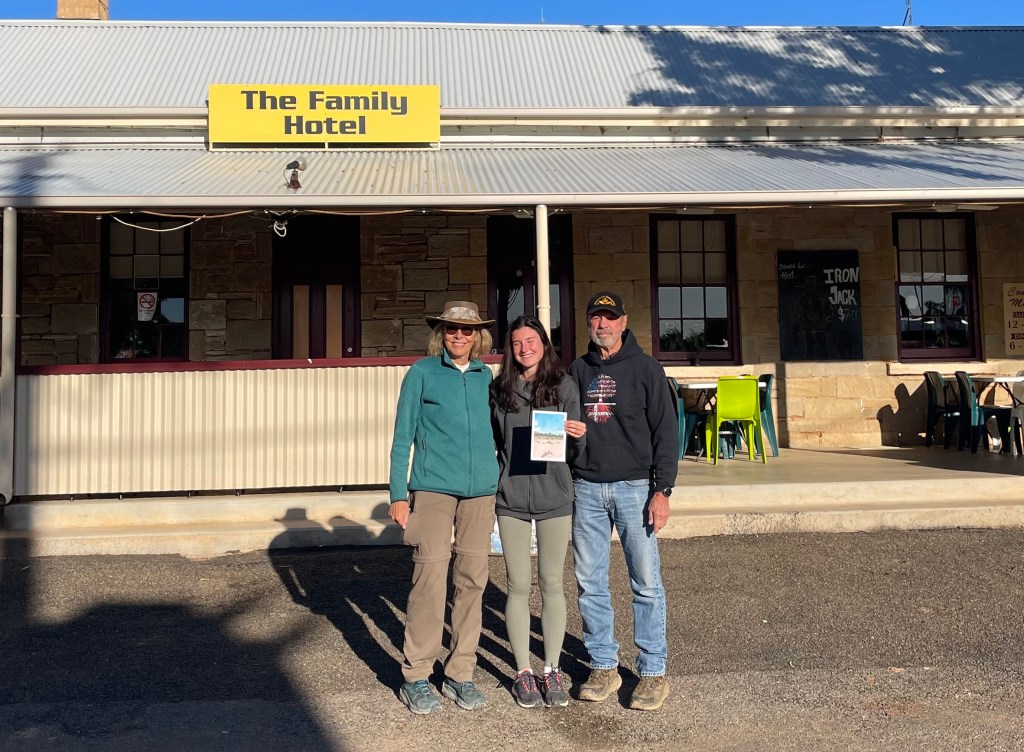
We check in at the family hotel, which Is directly opposite the family motel and gas pumps. The pumps partiallly explain why tibooburra exists. there’s a big diesel storage tank out behind the roadside pumps, making it a place where long-haul truckers could stop for fuel and possibly an overnight stay. the only other reason we could see was a life-size stuffed camel welcoming visitors at the entrance to town. holding the camel’s reins was a stuffed dark-skinned man wearing a typical afghan headdress. tibooburra, in addition to being at the entrance to sturt national park, which encompasses the northwest corner of new south wales, had once been a camel station!
We check in with the clerk at the family hotel, who leads us to our room. It’s in the back, just behind the bar. he opens the door to reveal a bed. that’s all. a bed. no nightstand, no chair, there’s no room for any of that. just a bed, which is not big but which takes up the entire room. The clerk then takes us down the hallway past a half dozen other “rooms” to show us the communal toilet facilities. I don’t know whether to laugh or cry. could this be where the long-haul truckers bed down for the night? I couldn’t imagine it.
fortunately, pernille found the manager, who informed her that, indeed, there were vacancies at the motel across the street, where traditional rooms with bathrooms attached could be had. Apparently, the terms ‘hotel’ and ‘motel’ in tibooburra mean the opposite of what they mean elsewhere. The motel was basic, but the rooms were several levels above the hotel facilities. For one thing, they were across the street from the bar, not right behind it.
After a restful(?) night’s sleep, we awoke and drove toward the queensland border, about 55km to the north. We knew the road in queensland had been closed since the rain, but we wanted to see how bad it was on the south side of the state line, approaching the border. There were rumors the queensland side would be open in a couple days, and our plans for the journey northward depended on it.
the individual states in australia are quite autonomous, to the point where, at least in the outback , fences mark the boundary lines. These heavy chain-link fences are ostensibly to keep wild dogs out, or in, depending on your point of view. Anyway, the gates are closed and unattended. Just past the fence on the other side of the state line we find a sign welcoming visitors to bulloo shire, queensland, but the sign doesn’t look all that inviting, and we already know the road is hazardous. We still have two days before traveling, and the sunny, dry weather is an ally.
It turns out the area around tibooburra is loaded with birds populating the semi-dry creek beds that cross the roadway. pernille stops at a creek just outside town and spots not one, but two birds she hasn’t seen before; the bourke’s parrot and the crimson chat. So score one for tibooburra. or two.
After a day scouring the bush, it’s back to base, where the sign on the hotel door informs that dinner is served from 6 to 9 p.m. it’s getting close to six, and as the hour approaches, there’s a rush of people toward the pub door. They’re apparently denizens of a bus that’s pulled into the town from god knows where.
Inside the hotel pub, we’re greeted by a crew of young people who are clearly not locals. For one, they don’t speak “strine”, the aussie version of english, and they all appear to be in their early twenties, whereas all the tibooburrians we’ve met make me look young (and feel old).
It only takes a sentence before we’re asked where we’re from. “texas,” I reply in my best southern drawl, sounding more like “tay-eck-sis”. “oh, we have a colleague from texas,”, one of them says. “Here she is”. And from the doorway appears a young woman wearing a dallas cowboys hoodie . She’s from ft. worth. rachel by name. not a cowboys fan, but hey. the other two are a young woman from the netherlands named jules and a fellow from nottingham in the u.k.. not a forest supporter, or even an english football fan, but a decent bloke who’s adept at drawing a perfect pint.
jules, we learn, is also a budding artist, and is making her first attempt at offering her work to the public. shy and humble, she’s offering them at whatever price a potential customer is willing to pay . “twenty-five dollars”, i offer, pointing to an attractive little watercolor in the display. “Yes,” she replies ecstatically. “that’s my first sale”.
jules holds the first painting she sold
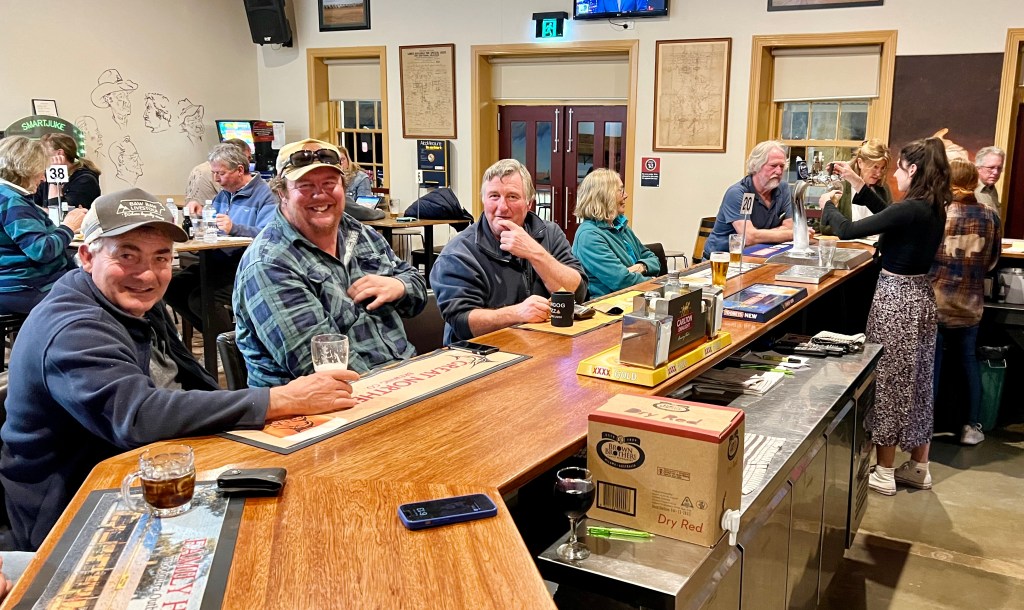
when we returned the next night for dinner (it was literally the only place in town), jules was talking to three men sitting at the bar. “they just bought a piece from me for $100,” she gushed. the three of them had commissioned her to do a portrait of them, and they were admiring it. not bad for a first-time amateur portrait artist. not bad at all.
three satisfied customers waiting as jules pours them a brew
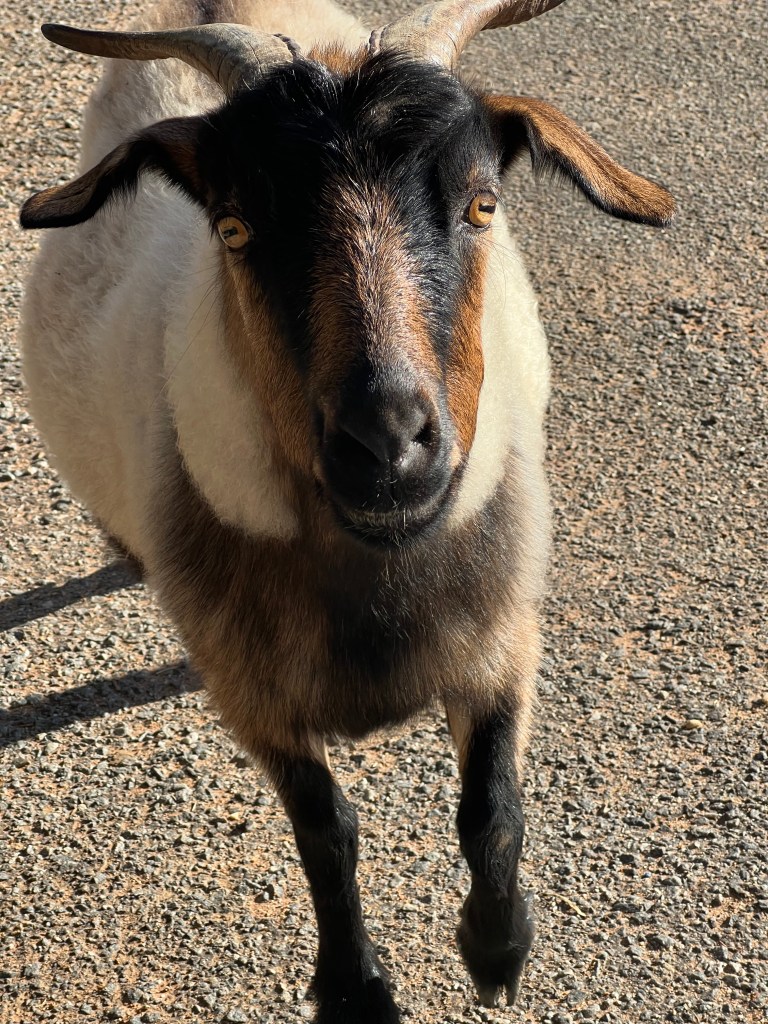
tibooburra may not be too long on people, but we learned it has a celebrity goat. we know this because he followed us as we wandered the street (singular), and wouldn’t let us go without taking his picture. he’s obviously been spoiled by people with cellphone cameras, and apparently thinks that’s what humans are for. he’s right. and to be truthful, he is photogenic.
goatie mc goat is a camera hog.
The next morning we decide the best use of our time is to test the road going west toward cameron corner, a post at the intersection where new south wales, queensland and south australia all meet. cameron corner makes tibooburra look like Manhattan by comparison. It’s just a small shed in the middle of the open desert, the perfect definition of a barren outpost.
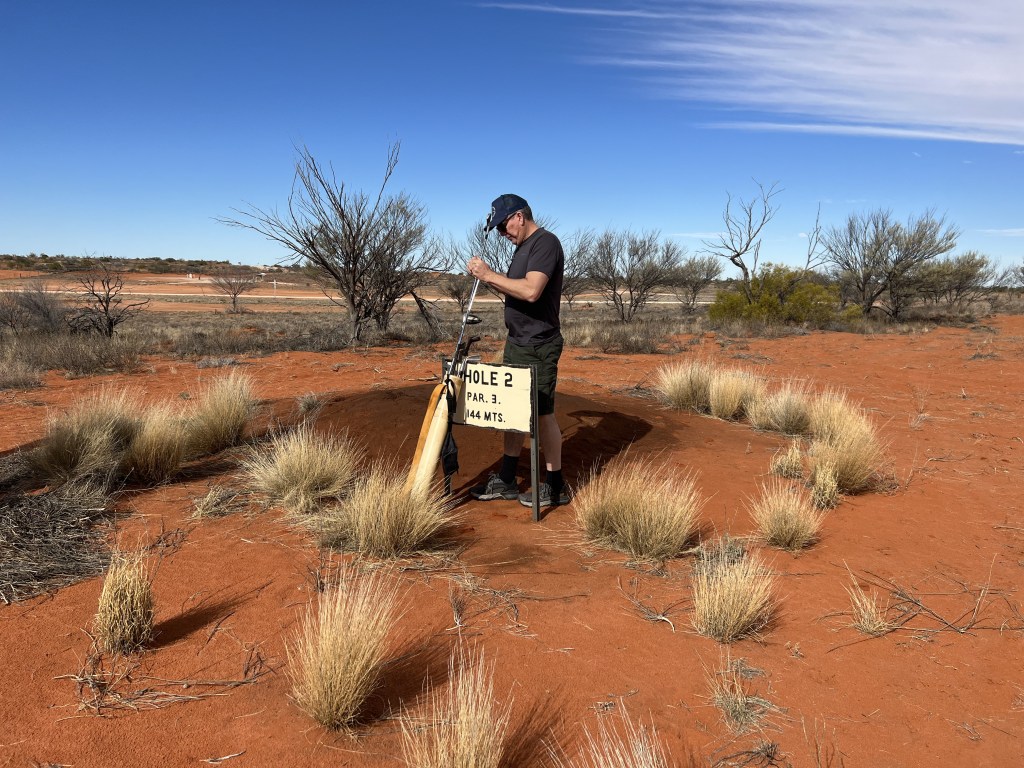
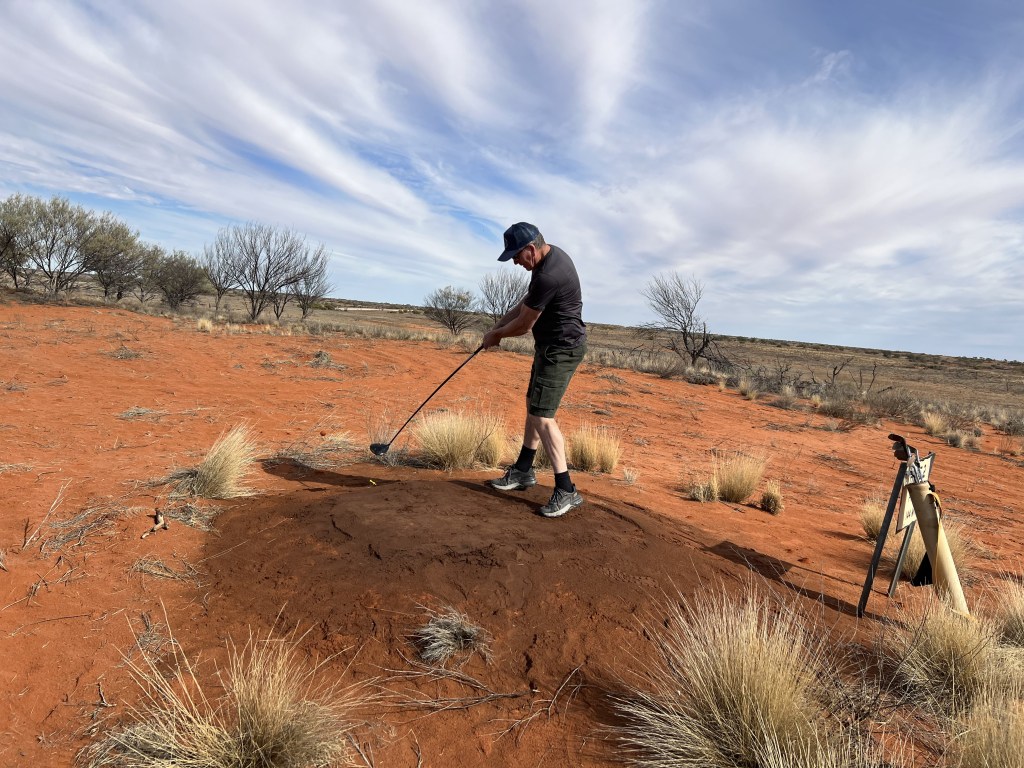
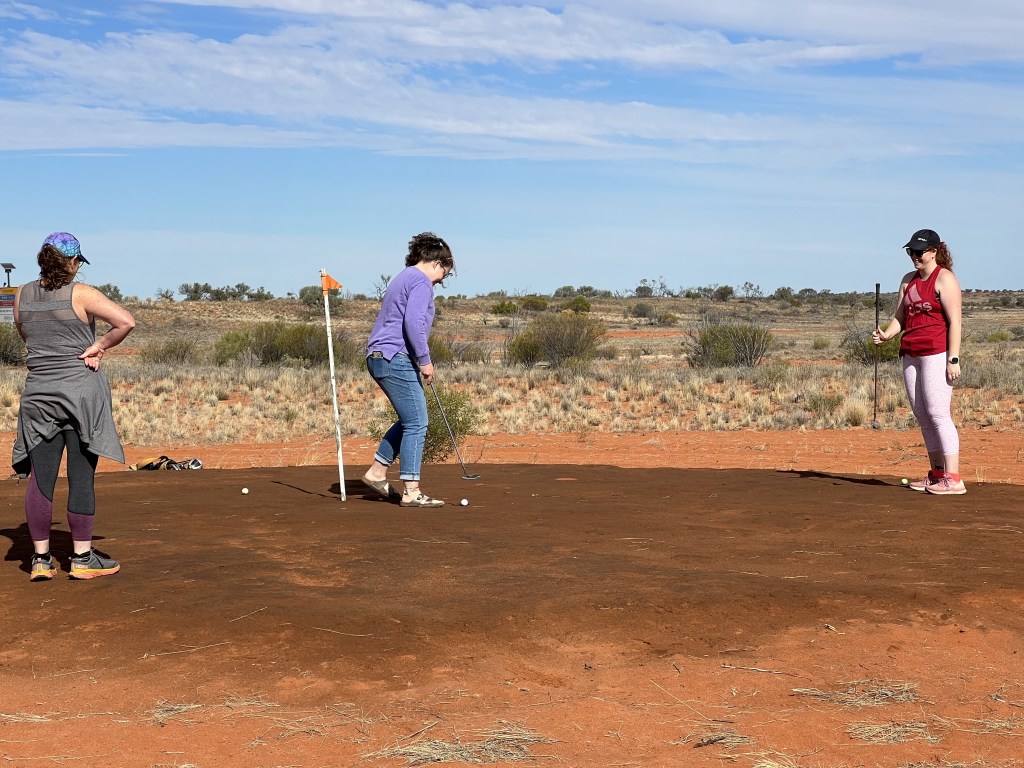
cameron corner is inhospitable by any standard, including the golf course. let me repeat that. … including the golf course. the golf course. just as we arrive, a foursome is checking out their gear at the clubhouse (the pub and only building in cameron corner) and heading for the front nine. (there are only nine. the mind boggles at the thought of what the back nine might be like at a place like this). It must be a quirk of the scottish- south australia sense of the ridiculous that requires a golf course anywhere there are people. st. andrews it ain’t, unless the holy man has become the patron saint of lost causes. but it has one unique attraction. the nine holes encompass all three states; three in each state. a family of four; father, mother and two daughters, have taken the bait, trudging through the sand, dodging spinifex bushes to reach “greens”, which are not green at all, but in fact are oil-soaked mud flats carved with gullies from the rains. The first hole is a par 3. scores among the foursome were 6, 9, 11 and “i don’t know”, but everybody made par, somehow. (tally courtesy of price-waterhouse.)
an unlikely foursome on unlikely links at cameron corner golf club
as we d rove away from cameron corner on the way back to tibooburra, we could see the four of them wandering the desert of south australia, searching for their balls. they may still be there.
view from the windshield – cameron corner
the following morning we steeled our nerves, packed up the car, and turned north toward the queensland border, this time for real. at the frontier fence we encountered three other couples standing just outside the gate, contemplating whether to risk the trip, given that the road had just opened that morning, following the floods. throwing caution to the winds, we flung open the gate and headed into the abyss of southwestern queensland for week three — the final leg.
a 3-week excursion to the near reaches of the australian outback
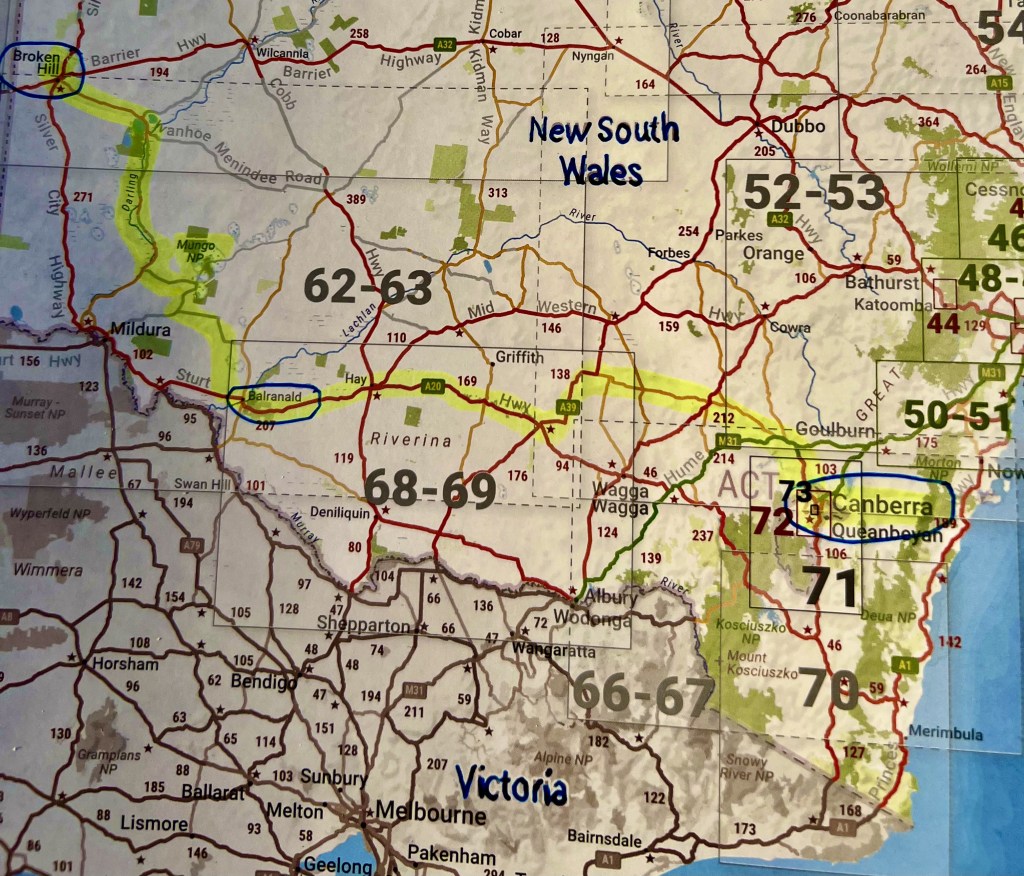
Week one— 1200km — canberra to broken hill
The odometer reads just over 23,000 kilometers as we pull the land rover out of its garage in the comfortable canberra suburb of yarralumla, bound for the australian outback. the car is packed for three weeks of the unknown, a stretch of land known for being inhospitable to travelers. we’ve even purchased a tiny propane water boiler for the occasion, just in case, and a real refrigerator that plugs into power outlets in the car (for beer and, who knows, possibly some food.) pernille’s got a master’s degree in (central) planning, so we’re prepared, like the bolsheviks of a century ago.
the outback has no boundaries, no lines on a map, no signs indicating you’ve crossed over from one state of mind to another. The change is almost imperceptible at first. it’s not like a swimming pool, where you dive in, and all at once you’re drenched. It’s more like a sunrise, where the blackness of night gives way by degrees, revealing itself like a striptease dancer, one garment at a time, till the orange orb rises over the horizon and you’re bathed in the light of a new reality.
the first leg is a lazy afternoon drive to temora, a tidy community where we had spent a weekend a few months earlier. on our last visit, billabong the dog and i bunked at a B&B while pernille spent the weekend with a pack of hard-core ornithologists placing tracking bracelets on the region’s birds.
this time we’re being hosted by our friends mark and gitte binskin, who have a “holiday house” alongside the temora airstrip and flight museum. gitte and mark, a former chief of the royal australian defence forces, have offered to put us up in their “dog house”, the hangar where their prized possessions are stored.
it’s a good omen. true to its name, the exterior of the dog house features a foot-high wrought iron snoopy dog in full battle regalia gracing the front entrance, appaently. inside the hangar is one of mark’s treasures, a genuine u.s. army “bird dog”, an olive green army vietnam-era two-seater reconnaissance plane that was used in wartime to seek out (bird dog) enemy targets just before the bombers struck.
The slow moving propeller-driven “bird dog” planes could easily have been shot down by the viet cong fighters hidden in the jungle below, but the planes were never attacked because that would have given away the enemy positions to the jets that would be arriving on bombing missions moments later. (or possibly because the VC couldn’t imagine any danger from a single-engine cessna.) mark’s “bird dog” sits in the hangar in perfect condition, decades after the war ended.
mark binskin’s pride. the vietnam-era u.s. army “bird dog” recon plane.
thursday the first of June, we begin our trek westward toward the back of beyond. The weather forecast is for clear skies through the weekend, followed by several days rain. First stop, leeton, a spot on the map known for its wetlands. We’ve been told to seek out a woman named cathy at the leeton information center. cathy is behind the counter when we arrive, and she informs us that a former leeton mayor and serious birder, paul maytom, is out at the town lake for his daily look around. She picks up her phone and paul is on the line in seconds, saying we could meet him at the entrance a few blocks away. Five minutes later we pull up at the entrance and there are paul and his wife julie, waiting to escort us through the gate and into bird wonderland. easy as that.
paul and julie maytom have little time for politicians making water policy for the outback.
I’m occupied with my iPhone camera, shooting up the surrounding birds with my 15x zoom cellphone lens. paul has a little doodad-looking camera on a strap around his neck, and from time to time he snaps one. Each shot is a stunner. his zoom lens captures every bird in perfect focus. as opposed to mine. i’m envious. his camera, it turns out, is a canon power shot SX-70 HS. i’m buying one as soon as we get home. expect an improvement in picture quality on this blog soon.
We stay too long at leeton, captivated by the ornithological wonders, and paul’s biting commentary on australia’s water politics. he and his mates in leeton are unequivocal in their contempt for the central planners in sydney and brisbane who dictate the distribution of water, ignoring the needs of the farmers and the wetlands that are the lifeblood of the regional (read rural) population. one of paul’s mates singles out a former deputy premier of queensland for criticism. “that damn barnaby joyce,” he observes. “he’s always serving the interests of big farma (the agricultural conglomerates), never giving a thought to the little farmer. they don’t give a darn about us.”
water is the topic on people’s minds out in this wetland-ish part of the outback. “water is gold,” paul tells us, as if quoting from the bible. “sometimes it”s floods, sometimes its drought. we have to be ready for whatever, because it’s (the water is) precious.”
soon paul and julie have to leave, but they entrust us to the care of another couple who carry on the anti-big city politician commentary until we realize that we’ve blown it. the locals’ trenchant analysis is fascinating, but we’re due that evening at an outback station, west of the town of balranald, nearly 200km down the road.
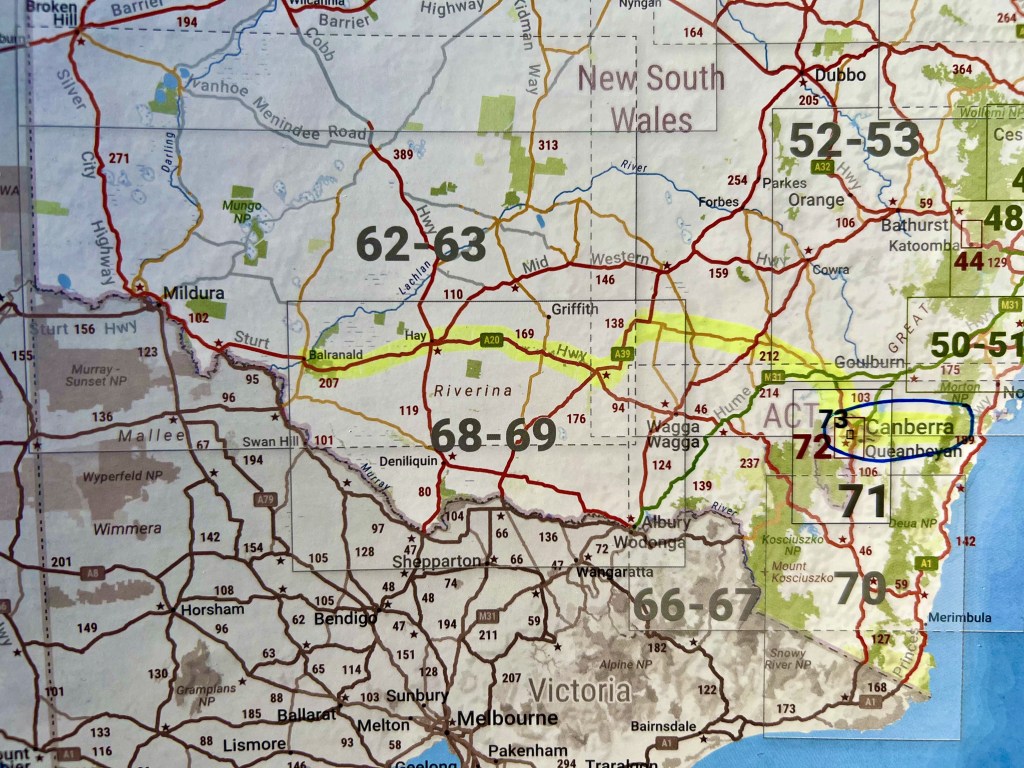
map of the southeastern corner of australia, where most of the people live
we hightail it out of leeton, but the race is lost before it’s begun. by the time we reach balranald, the orange orb is staring us in the face. as we race west. our failure is blindingly obvious as we watch the day’s end taunting us on the horizon. as we pull in to balranald, pernille’s cellphone rings. It is our host for the evening anxiously asking when, or if, we are coming. she instructs us that it’s 17km from balranald to the farm station, but by the time we negotiate that 17km, it’s nearly dark, and the entrance light she tells us to look for is facing the wrong direction, so we miss it. when we reach the 20km mark, we realize we’ve gone too far and drive back to the gate.
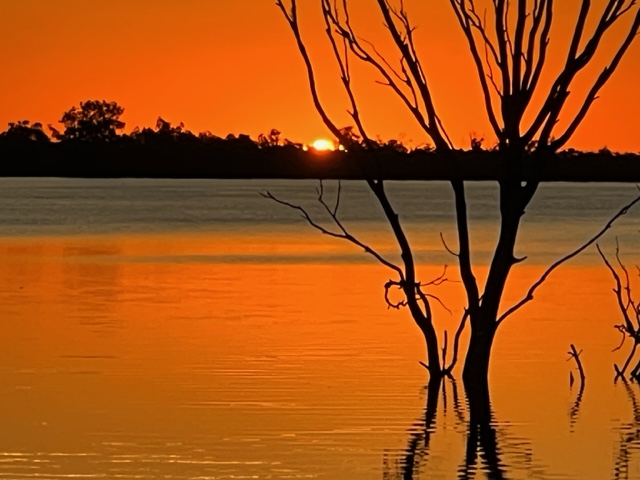
As we pull up outside our residence for the evening, it’s immediately apparent why our host was so anxious about our arrival. sunsets over the water at lake paika are grandiose, and they wait for no one. all we get to witness are the last few flickers of what had been; the final notes of a grand symphony. we can almost hear the audience rising in applause for the final curtain call as we unpack. opportunity missed.
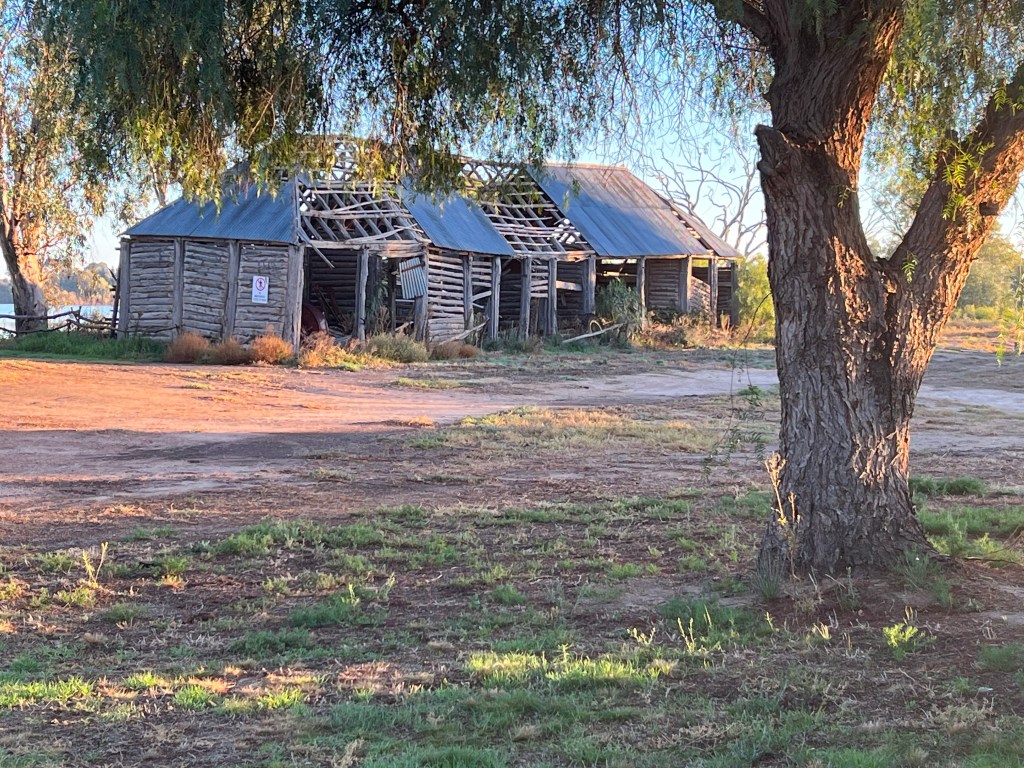
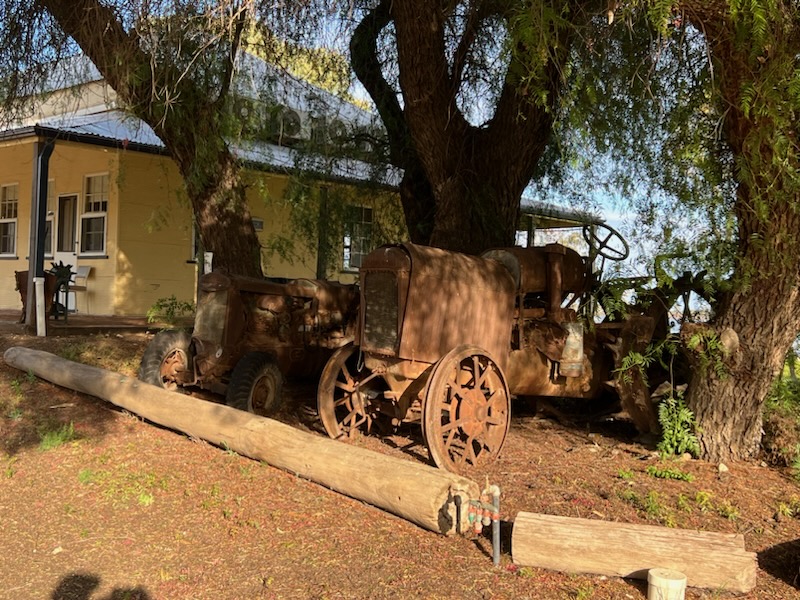
The following morning makes up for the previous evening’s loss. The rising sun on paika station’s 19th century farmstead brings out the ochres and pastels reminiscent of old time photographs and paintings. in the words of the old fleetwood mac song, we pick up the pieces and move on.
all too soon, it’s time for the day’s drive to mungo national park, one of the highlights of the new south wales outback. our guide for the day is german (and he’s not german). herman, as he pronounces it, it a chilean transplant who’s built a reputation as one of the region’s most knowledgeable birders and all around entertainers. we’re joined for the day by max, a retired brisbane barrister who’s taken up bird photography in his dotage. he’s equipped with a nikon DL480 camera (the best) with one of those foot-long telephoto lenses that you see sports photogs lugging around. it’s a beauty and he knows how to use it.
“mungo not gay”, to paraphrase alex karras’s classic line from the 1970s movie “blazing saddles”. mungo fabulous. we return from a day at mungo park agog at the wonders, including a flock of rare “major mitchell” cockatoos feasting on melons in the middle of the road ahead of us. major mitchells! a birding coup. thanks, max, for the high-quality image below.
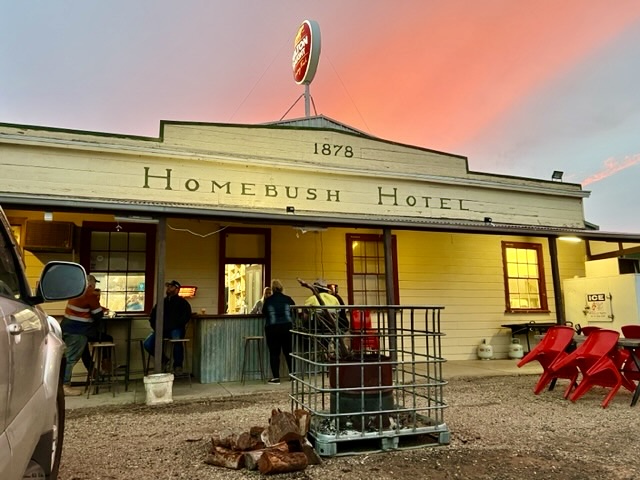
heaven is a comfortable pub after a thirsty day in the bush, and on the road home we pass by a place called the homebush hotel a few miles outside paika station, just as the bright orange ball is sinking into the bush in a red western sky. it fits the bill. the homebush is a stereotypical hollywoodesque outback roadside inn, with regulars straight out of central casting. our beers disappears in the blink of an eye, (or “oyeblik” as the danes would say). but the red streak in the sky above the hotel makes a lasting impression. “red sky at night is an outback delight”, to paraphrase and old sage.
the following night we make it back in time for the fiery finish at paika station. second time lucky.
next up, we turn north for the trek up to to bindara on the darling, a darling farmstead on the banks of the darling river, operated by a darling woman named barb. “outback beds with friends” is the name of a small band of wilderness farmsteads, and barb is a friend forever.
she’s the quintessential aussie frontier woman, tough as nails but tender as a baby’s bum. married at 18, she’s now a 60-ish grandmother with a 17-year old granddaughter who has some mighty big shoes to fill. barb and her late husband, bill, bought the lovely riverside farmstead when it was still a thriving sheep-shearing station in the last (20th) century. bill died after a long illness brought on by inhaling noxious fumes while working at a neighboring farm, so barb has carried on the family business by joining together with other (mostly female-operated) country bed & breakfast homesteads to create “outback beds with friends”.
the “outback beds” network encompasses tens of thousands of square kilometers across the vast and sparsely populated far western quarter of new south wales/queensland. the farms are so widely dispersed through the outback that the owners rarely see each other, but they’re offering a special volume discount. anyone who stays a three or more of their properties qualifies for a complimentary tea towel. (spoiler alert: we’re the proud owners of an outback beds tea towel)
the bindara farmstead comes with an extra friend as well–michael, a long lost acquaintance of barb’s who’s stopped in, ostensibly on his way back to adelaide home from a lawn-bowling tournament in renmark, a town far to the northeast. he’s parked his caravan outside the guest quarters, and while he’s quick to point out that he’s not staff, only passing through, he appears eager to help barb with chores around the farm. he’s a strapping 6’5″ fellow who has brought along a saw to trim low-hanging branches from trees around the farm. and after dinner, he helps with the kitchen chores, then pulls out a fancy guitar from the cab of his truck and proves to be an entertainer, as well.
michael has a thick book filled with lyrics of songs he says he hasn’t played in years, from which he produces one after another sing-along folk tune by artists from john denver to gordon lightfoot to roger miller and on and on into the night. he also has a repertoire of old scottish/australian sheep-shearing songs that he picks with precision. entertainment worthy of a good night club, and at “friends” bargain basement prices. (free)
bad news. our second day at bindara, as predicted, the clouds open up and deliver a steady sheet of soaking rain. not a gullywasher, but enough to turn the dirt roads into mud-red ice rinks. barb takes us out for a spin (literally) in her SUV, to show us the hazards that await on our upcoming drive northward toward broken hill. the undriven roads look perfect, but it’s like navigating across an icy lake. any misstep and you could be mired in red goo up to your wheel wells at a place out of cell phone range and inaccessible to rescue vehicles. this is where flying doctors are often the only hope for the injured. roads are too risky. we were happy to learn that denmark’s crown princess mary, who just happens to be an aussie, is the patron of the flying doctors.
and so it is with a great deal of apprehension that we load up the land rover and point it in the direction of the largest town on our itinerary, broken hill, and week two of the great outback adventure. the odometer reading is just over 24,200 km. we’re a third of the way (1200 kilometers) in. see you next week.
just take a white tern, then a left. you can’t miss it.
man1: who’s old enough to remember the old abbott and costello skit
“howe’s on first?“
man 2: no, that was “who’s on first?”
man 1: no, who’s on second. howe’s on first.
man 2: then who’s on third?
man 1: no. what’s on third. who’s on second and howe’s on first.
man 2: that’s LORD howe to you. but if what’s on third, who’s on second and lord howe’s on first, who’s batting?
man 1: no, who’s on second. why’s batting?
by now, lord howe, your brown cow is showing. even abbott and costello would be confused.
you’ll be forgiven if you’ve never heard of lord howe “brown cow” island. it’s a windswept speck of rock in the south pacific ocean, maybe 750 kilometers off the east coast of australia, much of which consists of two massive, uninhabitable chunks of hardened lava that shot up from the ocean floor into the clouds about 6.9 million years ago. the remainder is home to a tiny but well preserved little community of about four hundred people who go about their daily business as if they were just an ordinary part of the australian state of new south wales. that daily business mainly consists of hiring out snorkeling and scuba gear (and bicycles) to well-heeled folks who arrive in search of the magnificent coral reefs in the surrounding waters. and of course renting upscale apartments to those visitors when they come up for air.
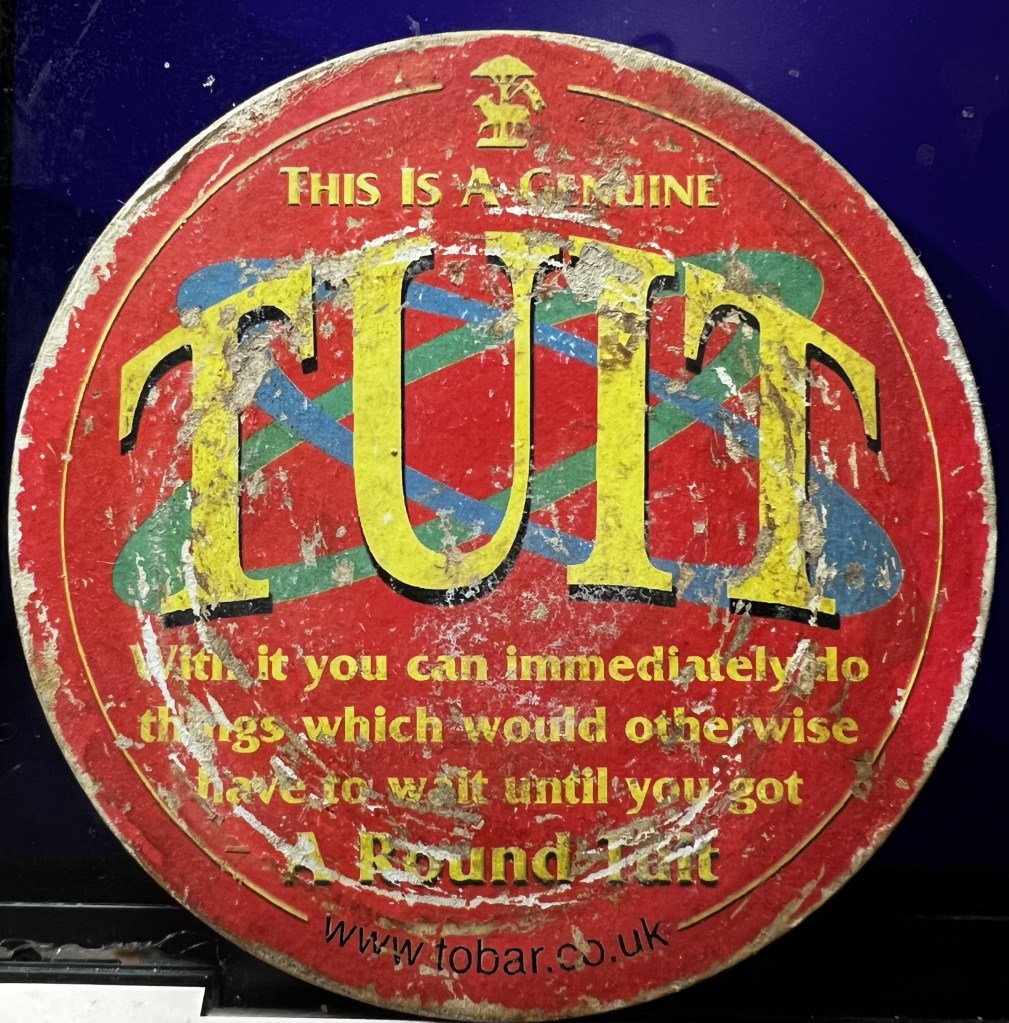
lord howe (brown cow) island is not for everyone. for one thing, there’s a strict limit on the number of outsiders allowed on the island at any one time. that number is four hundred, about equal to the number of locals. so if you have a hankering to visit, get in line. they’ll see you when they get around tuit.
second, it’s not for people with high-stress lives. on the island, you’re at the mercy of the elements. just about the only access is by air, and the landing strip is a thin ribbon of concrete that runs across the middle of the island, literally from one beach to the other, a distance of less than a kilometer. if the weather acts up, as it is wont to do, you’re SOL. (shirley outa luck). lord howe must be the destination for which the term “puddle jumper” was coined. our first scheduled flight to the island was cancelled when a thunderstorm inundated the runway, and it was touch and go the next day for a flight that departed the mainland at 5:45 a.m. so don’t depend on firm arrival and departure times. you’ll get there when you get there, and you’ll leave when mother nature waves her fickle wand.
and oh, while you’re there, forget about using your cell phone. there’s no service. none. so feel free to spend your time searching the ocean bottom. you won’t miss a call. guaranteed. and you won’t have to worry about the island’s current pandemic threat, poison myrtle rust. we never got clear on exactly what poison myrtle rust is. it’s some kind of a rare fungus. but the island park service has declared a medical emergency, and has positioned hand disinfectant and boot washing stations at the entrance to every hiking trail, so you can’t miss them if/when you go for a walk in the neighborhood.
once hands are sanitized, it’s time to eat, and there, you can’t miss. the island’s restaurateurs figure if you can afford to visit lord howe (brown cow), you can plunk down the cash (or plastic) for a quality meal. the half dozen or so culinary establishments on the island are all top flight. even the burger joint, which doubles as the general store, serves up a pretty perky patty. lord howe (brown cow) island is similar to the mythical town of lake wobegon, where all the children are above average. here, every dish served is a da vinci or a van gogh, meals so fine you hate to spoil them with a knife and fork. bring a camera.
for rainy days (and there are plenty), there’s the museum. well worth the price of admission. (it’s free). honestly, though, it offers a fascinating glimpse into the island’s past, both geological and australian. and it’s compact; you can be in and out in an hour.
the museum is the repository for local news, and as it’s tiny, the local paper makes a big deal of even minor developments, since they’re all minor on lord howe island. when new south wales noticed the island’s existence, the local paper was suitably outraged.
from the museum we also learned about ball’s pyramid, a triangular wall of rock that sits tantalizingly on the southern horizon from lord howe island. it’s just a rock wall, uninhabitable for humans, but some seabirds apparently find it irresistible, judging from the massive piles of guano covering some of the rock faces. we booked a boat ride out to the pyramid one morning, which was also supposed to be for snorkeling, but the diving was cancelled due to the puke-inducing swells in the water around the pyramid. seasickness pills were at a premium.
for snorkelers/scuba divers, lord howe island boasts the world’s southernmost coral reef. sinus troubles kept us from doing much diving/snorkeling, however, as the saline solution (sea water) drains my sinuses something powerful. after only a few minutes breathing through the snorkel tube, my addled lungs were rasping like an old saw.
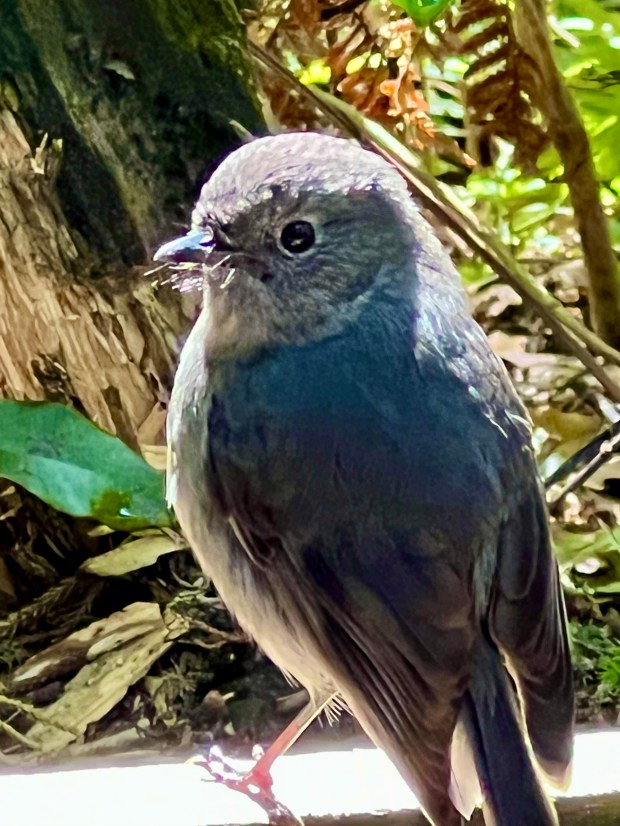
the stars of the show, from one twitcher’s (bird watcher’s) perspective, are the winged creatures. the avian inhabitants of lord howe island differ from those on the mainland. therefore, anyone looking for notches on her birdwatching belt is going to find lord howe a royal goldmine. and she did.
good lord, howe she did revel in the island’s birdiversity. there’s no equity among birds, no inclusion either. but diversity, omigod. they’ve got it in spades. and hearts and diamonds. (oddly, no clubs. see below)
from a photographer’s perspective, lord howe island is exceptional. the birds seem to think the humans are there to photograph and admire them, which they are, so the winged creatures have no qualms about setting down just outside touching distance. no telephoto lens needed. a few species were a bit standoffish, but there’s plenty to photograph without those snobs.
same with the fish. they just hang out in huge bunches (schools? universities?) a foot or two off shore, waiting for snorkelers to wade in so they can harass them for treats. it’s gotten to the point where the beach council (yes they have a beach council) now provides little containers of “fish food” to placate tourists eager to comply with the fishes’ wishes. only problem is, just as with the birds, the big fish get all the goodies, leaving the little guys to scrounge for scraps. that hasn’t scared off the smaller fish, though. they’re still there in such large numbers that it seems they have little “fish traffic jams”. i wonder if sometimes a fish gets distracted and rear-ends the fish in front of him. don’t ask why they put up with such seemingly hopeless odds. they must know something we don’t. but there were no starving fish around lord howe island, that’s for sure.
sure, you’ll be forgiven for forgetting lord howe (brown cow) island. at only 400 visitors at a time, the chances are slim to none (and slim just left town) that you’ll ever get to this little dot in the south pacific. but it’s worth remembering that there still exist a few throwbacks to the days of yore, where bicycling a few minutes to the shore for a snorkel or scuba was all in a day’s fun. thank lord who, however he was.
hooray! a round tuit
and…. oh, look! a round tuit! lord howe’s beach council gets a round tuit. to granting you a tourist visa. so by all means, put in your application. if they’ve gotten a round tuit, who knows what’s next. maybe ball’s pyramid will erupt again. it’s been 6.9 million years since the last one. it’s about time they got around tuit.
























 not that heinlein